Sunday, July 1, 2012

William Ayers' forgotten communist manifesto: Prairie Fire

William Ayers is a communist. But don't take my word for it. He said so himself:

And not some nicey-nice peace-and-love kind of communist. Through his group the Weather Underground, Ayers was planning to "seize power" in a violent communist takeover of the United States:

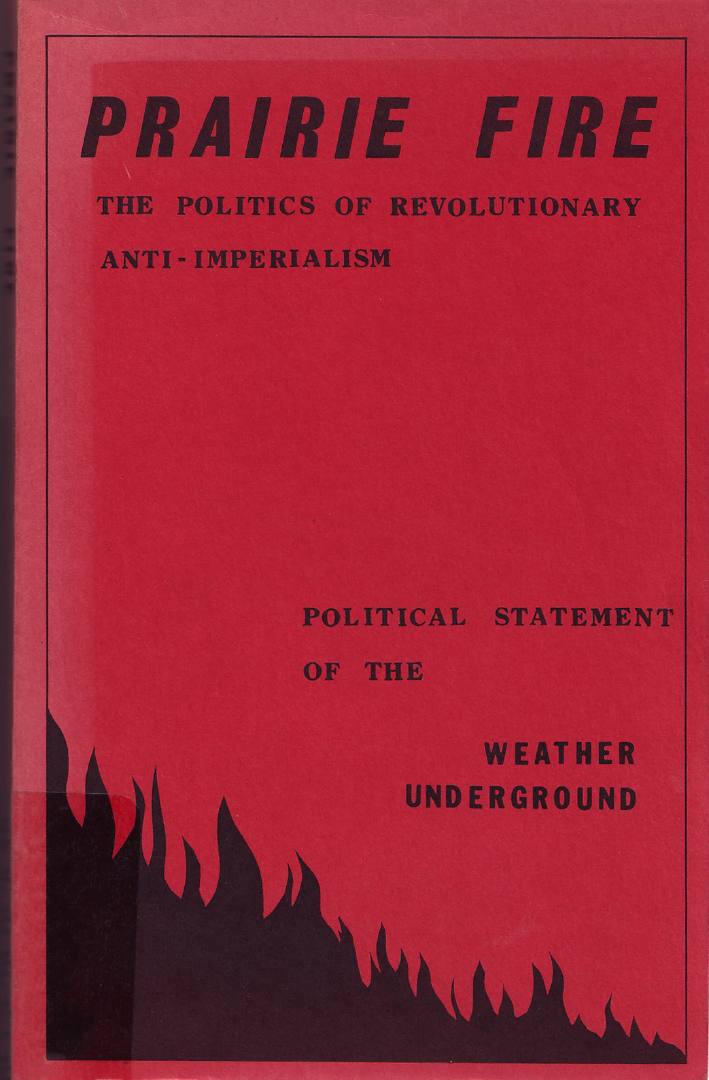
The quotes above were scanned directly from a now long-forgotten book entitled Prairie Fire: The Politics of Revolutionary Anti-Imperialism, which was written and published in 1974 by William Ayers, Bernardine Dohrn and other members of the Weather Underground. In this slim volume, which functioned as the Weather Underground's ideological manifesto, Ayers declares himself to be a communist, and announces that his group's bombing campaign was intended to start a violent revolution to overthrow the American government.

After a long search, I was lucky enough to finally get my hands on a copy of the original edition of Prairie Fire, which is now extremely rare and hard to find. It was written in secret while Ayers and his fellow Weather Underground members were still in hiding and on the run, and still actively engaging in bombings and other violent acts.

This essay features many high-resolution scans of quotes and entire pages taken directly from Prairie Fire, which journalists, bloggers and other media members are free to copy and re-post.

If you're interested only in viewing or downloading the scans taken from Prairie Fire, scroll down this page to see a large selection of shocking quotations which you can use as you see fit. My introductory explanation below simply provides context and elucidates why the text of Prairie Fire is so significant at this very moment in history.

So far in 2008, there has been almost no mention of this manifesto and its insurrectionary goals. It seems as if the media, William Ayers, Barack Obama and his supporters don't want you to know about Prairie Fire. Which is exactly why you need to see it.

How Is This Relevant to the 2008 Presidential Campaign?

There's nothing illegal about being a communist. People in this country are free to hold whatever political beliefs they so choose. I don't know William Ayers, I've never met him (that I'm aware of), and I have nothing against him personally.

This essay only exists to correct and unequivocably debunk claims routinely made by the mainstream media over the last few weeks about William Ayers, his beliefs, and the purpose behind his bombing campaign during the 1970s.

Specifically, when questions arose during the 2008 presidential race about Barack Obama's past associations with William Ayers, many media reports and articles blandly described Ayers as a "Vietnam-era radical" and the Weather Underground as a group that set bombs "to protest against the Vietnam War." Both of these characterizations are demonstrably inaccurate.

Furthermore: Obama and his supporters at first claimed he barely knew who Ayers was, but when public awareness of the connections between Obama and Ayers became too numerous and too strong to deny, Obama's supporters have now begun resorting to a fallback position: that William Ayers wasn't such a bad guy after all, and that it is no shame to be associated with him. The now-standard talking points are:


• Ayers was simply protesting against the Vietnam War, and a lot of people protested against the Vietnam War back then, so there's no shame in that.

• Ayers was never actually convicted of setting any bombs or killing anyone, so there's no real proof that he ever did anything wrong.

• Ayers is now a respected, mainstream, mild-mannered and popular professor, so obviously his political views couldn't have been that extreme.
This essay disproves all of these claims. The text that William Ayers authored in Prairie Fire, and the additional documentary links provided below, prove that:

• Ayers was not simply protesting "against" the Vietnam War. Firstly, he wasn't against war in principle, he was agitating for the victory of the communist forces in Vietnam. In other words: He wasn't against the war, he was against our side in the war. This is spelled out in great detail in Prairie Fire. Secondly, and more significantly, the Vietnam War was only one of many issues cited by the Weather Undergound as the justifications for their violent acts. As you will see below, in various quotes from Prairie Fire and in their own list of their violent actions (and in additional impartial documentary links), Ayers and the Weather Underground enumerated dozens of different grievances as the rationales for their bombings -- their overarching goal being to inspire a violent mass uprising against the United States government in order to establish a communist "dictatorship of the proletariat," in Ayers' own words.

• Ayers and his co-authors freely brag about their bombings and other violent and illegal acts, and even provide a detailed list, most likely typed up by Ayers himself, of the crimes they had committed up to that point. Ayers' list, scanned directly from Prairie Fire, is shown below. He may have escaped conviction due to a legal technicality (the prosecutors failed to get a warrant during some of their surveillance of the Weather Underground), but this in no way means that Ayers was factually innocent of the crimes. As has been widely reported, after the case against him was dropped, Ayers decribed himself as "guilty as hell, free as a bird."

• Just because Ayers tries to appear respectable now doesn't mean that he wasn't a violent revolutionary in the past. In fact, as the text of Prairie Fire shows, Ayers was one of the most extreme extremists in American political history. And as the links given as the end of this essay will prove, Ayers is just as politically radical now as he was back then. He has never renounced the political views he professed in the 1960s and 1970s. The only difference is that now he no longer commits violence to achieve his goals. After his stint as the leader of the Weather Underground, he shifted to a different tactic: to spread his ideology under the aegis of academia. But the goal remains the same: to turn America into a communist nation. Ayers' contemporary writings contain many of the same ideas (and even the same phrases) found in Prairie Fire, just toned down to make them more palatable in polite society.
But Where Is the Obama Connection?

This essay is only about William Ayers' past and present political views. It is not about the connection between Barack Obama and William Ayers. That issue has been covered (and continues to be covered) elsewhere in innumerable news reports and blog postings. Yet as evidence mounts of the extensive and long-standing connection between Obama and Ayers, making their association more and more difficult to deny, Obama's campaign and supporters have started shifting their strategy; Sure, they say, Obama may have had a connection with Ayers, but why is that so bad? Look at William Ayers now: He's a completely respectable man. What -- he protested against the Vietnam War? So did everyone. He's no extremist. I see these arguments made in countless blog posts, comment sections, and even news articles. This essay exists to stop that political escape route. There's no getting around it: William Ayers was a violent communist revolutionary bent on overthrowing the government and "seizing power" in the United States. The proof is on this page. And the only difference between the 1970s William Ayers and the William Ayers with whom Barack Obama has associated is that Ayers no longer uses violence to achieve his goals. But Ayers' underlying political world-view (i.e. communism) has remained the same.

For the record, and just to be complete, here are links documenting some of Obama's many connections to William Ayers:

• Ayers and Obama worked together for years on a school reform program called the Chicago Annenberg Challenge.
• Ayers and Obama also served together on the board of the Woods Fund of Chicago, a separate charity organization.
• Obama had his political coming-out party in William Ayers' home.
Ayers mentions Obama by name in a book he wrote in 1997, and mentions that the two are very close neighbors.
• Obama gave a short glowing review of that same Ayers book for the Chicago Tribune.
• Obama and Ayers were both presenters together on a panel about juvenile justice (organized by Michelle Obama).
• Both Obama and Ayers were close friends with the same person, Rashid Kalidi.
• There are also several unverified rumors swirling around that have not been documented: That Ayers may have helped to write part (or all) of Obama's autobiography; that Obama and Ayers shared an office space together for three years, on the same floor of the same building in Chicago; and that Ayers and Obama may have known each other as far back as 1981.

Authorship of Prairie Fire

How do we know that William Ayers himself co-authored Prairie Fire? Doesn't the cover say it's by The Weather Underground as a group, and doesn't mention him specifically?

Well, it's simple enough to prove. Because in the introduction, the four actual authors sign their names -- Bernardine Dohrn, Jeff Jones, Billy Ayers, and Celia Sojourn:
(A scan showing this section in context on the full page in Prairie Fire can be found below, lower down in this essay.)

Of course, in true communist spirit, earlier in the Introduction they mention that the book grew out of "study groups," "conversations" and "struggles" of the entire Weather Underground, but the four members listed above are the ones who actually sat down and wrote the manuscript. And of those four, "Billy" Ayers and Bernardine Dohrn were the most educated and literate, and were the acknowledged leaders of the group, so it's almost certain they did the bulk of the writing. (Especially considering, as I'll show below, the similarities between ideas in Prairie Fire and contemporary writings by William Ayers.)

But that's not all. On his own blog, in his own resumé, Ayers lists himself as the author of Prairie Fire. Which is as conclusive as you can get.


The Evidence

The rest of this essay consists primarily of scanned pages taken directly from an actual physical copy of Prairie Fire printed in 1974. As you will notice, the production quality was fairly crude, with some pages being typewritten (possibly by William Ayers or Bernardine Dohrn themselves) with others typeset in varying fonts, and then printed somewhat inconsistently with different densities in different sections of the book. While this may have lent Prairie Fire an air of outlaw authenticity when it first was distributed, it looks rather odd and irregular in the era of computers and modern typography. I only mention this detail here to explain why the various scanned pages and quotes seen below look different from each other.

PLEASE NOTE: For each of the full-size scanned pages displayed below, if you click on the image, your browser will open a new window showing a high-resolution version of the scan. I provide the hi-res scans as proof that this evidence is real, and in case anyone wants to inspect the text in more detail.

The individual quoted lines scanned below are already high-resolution, so there is no need to click on them. In a few instances, the quoted sentences start or end in the middle of a line; in those cases, I only display the relevant quote in question; I do not include the text on the remaining portions of the lines.

Underneath each scanned image is a transcription of some (or all) of the text shown, to make things easier for bloggers and journalists to copy and paste the sections which interest them.

(The full book is over 150 pages long, so I necessarily can only present a small selection of pages here. But nearly every paragraph on every page throughout the entire manuscript is jam-packed with the exact same kind of communist/socialist/revolutionary verbiage you see here. If you want to see more, or if you simply want to confirm that all of this is true, I encourage you to seek out your own copy of Prairie Fire; a few copies can still be found in major libraries and through rare book dealers.)

Below the scanned images is a final section providing quotes, links, videos and documentation proving that William Ayers maintained his political beliefs essentially unchanged throughout the '80s, '90s and 2000s, during which time he was accepted into the upper echelons of Chicago society, mingling and working with academics, activists and politicians -- including Barack Obama.

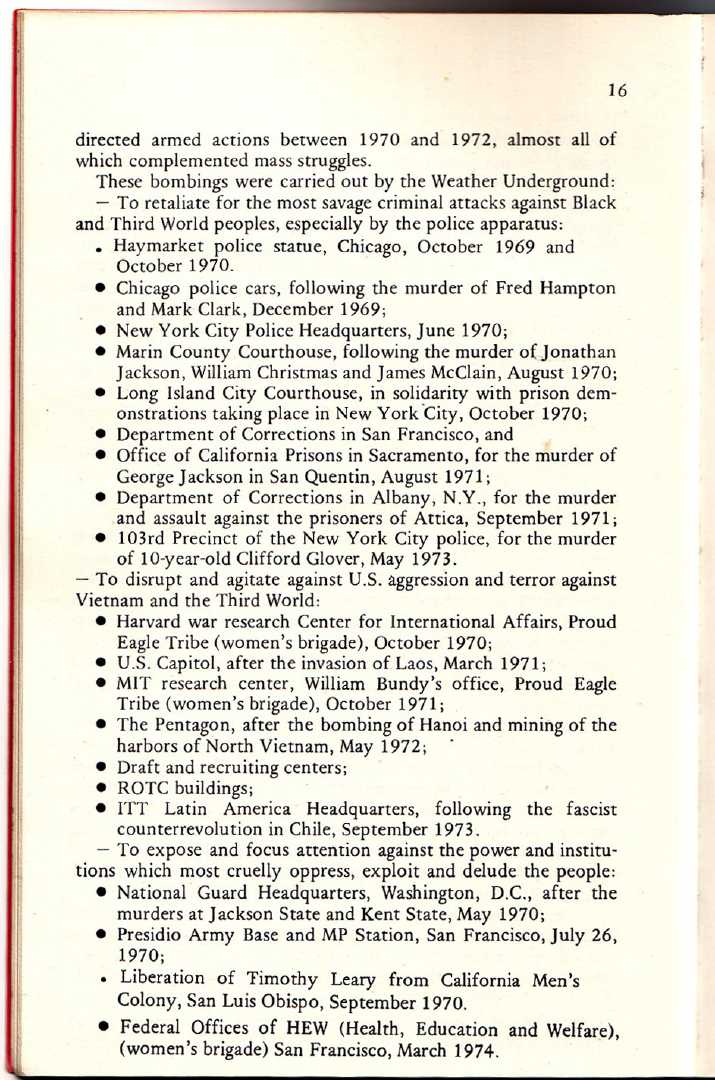
Page 16: The Weather Underground's own list of their terrorist bombings and other crimes

On page 16 of Prairie Fire, Ayers and his fellow co-authors brag about their numerous acts of domestic terrorism, and provide a handy list detailing not only each crime but in most cases the justification for each crime as well. Note an important detail: Most of the stated rationales for the Weather Underground's violent acts have nothing whatsoever to do with Vietnam. This disproves the ubiquitous media assertion that Ayers and the Weather Underground were "Vietnam War protesters."

Also note Wikipedia's list of Weather Underground actions that provides additional details regarding their putative justifications, including bombing a bank "in solidarity with striking Puerto Rican cement workers" and bombing a federal office building due to "the need for women to take control of daycare, healthcare, birth control and other aspects of women's daily lives," among many others which make no mention of Vietnam. Also note that the bombings and other violent acts continued after Prairie Fire was published, and that all the Weather Underground "actions" in 1974 and '75 happened after the United States had already pulled its ground troops out of Vietnam and was no longer an active combatant in the ground war, which would have rendered any Vietnam War protests pretty much meaningless.

Click on the image below to see a hi-res version:
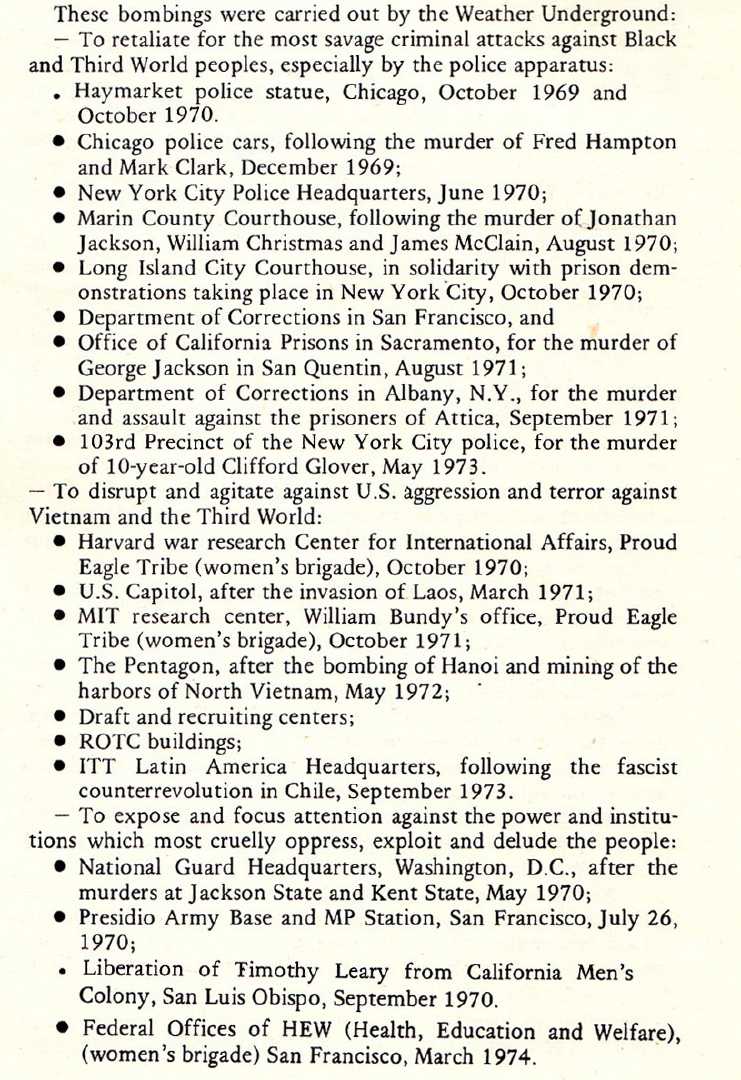


For the record, to prove beyond any doubt that this is real, click on the small image below to see a high-resolution scan of the entirety of page 16 in full context, including the edges of the book cover, the crease in the center of the book, and so on:


Page 10: The Start of the Chapter 1

The main body of Prairie Fire begins on page 10, after various introductory pages. The following four scanned images are all short quotes taken from page 10. Below each quote is a transcription of the text. The final image of this section shows all these quotes in context in the book on page 10 itself.

We are a guerrilla organization. We are communist women and men, underground in the United States for more than four years.
Here is the same quote repeated again, this time with additional context, in the form of the subsequent two sentences:
We are a guerrilla organization. We are communist women and men, underground in the United States for more than four years. We are deeply affected by the historic events of our time in the struggle against U.S. imperialism.
Our intention is to disrupt the empire, to incapacitate it, to put pressure on the cracks, to make it hard to carry out its bloody functioning against the people of the world, to join the world struggle, to attack from the inside.

THE BANNER OF CHE

The only path to the final defeat of imperialism and the building of socialism is revolutionary war.

Revolutionary war will be complicated and protracted. It includes mass struggle and clandestine struggle, peaceful and violent, political and economic, cultural and military, where all forms are developed in harmony with the armed struggle.
Without mass struggle there can be no revolution.
Without armed struggle there can be no victory.

The following scan shows the full two-page spread of pages 10 and 11. Page 11, as you can see, is a picture of Che Guevara. A full transciption of the text is below the image.


10

The unique and fundamental condition of this time is the decline of U.S. imperialism. Our society is in social and economic crisis and assumptions about the U.S. are turned on their heads. These are hard conditions to live through. But they are favorable for the people and for revolution.
These conditions of constant change demand the weapon of theory. Like people everywhere, we are analyzing how to bring to life the potential forces which can destroy U.S. imperialism.
We are a guerrilla organization. We are communist women and men, underground in the United States for more than four years. We are deeply affected by the historic events of our time in the struggle against U.S. imperialism.
Our intention is to disrupt the empire, to incapacitate it, to put pressure on the cracks, to make it hard to carry out its bloody functioning against the people of the world, to join the world struggle, to attack from the inside.
Our intention is to engage the enemy, to wear away at him, to harass him, to isolate him, to expose every weakness, to pounce, to reveal his vulnerability.
Our intention is to encourage the people, to provoke leaps in confidence and consciousness, to stir the imagination, to popularize power, to agitate, to organize, to join in every way possible the people's day-to-day struggles.
Our intention is to forge an underground, a clandestine political organization engaged in every form of struggle, protected from the eyes and weapons of the state, a base against repression, to accumulate lessons, experience and constant practice, a base from which to attack.

THE BANNER OF CHE

The only path to the final defeat of imperialism and the building of socialism is revolutionary war. Revolution is the most powerful resource of the people. To wait, to not prepare people for the fight, is to seriously mislead about what kind of fierce struggle lies ahead.
Revolutionary war will be complicated and protracted. It includes mass struggle and clandestine struggle, peaceful and violent, political and economic, cultural and military, where all forms are developed in harmony with the armed struggle.
Without mass struggle there can be no revolution.
Without armed struggle there can be no victory.
It will not be immediate, for the enemy is entrenched and intractable. It will require lengthy, deliberate political and armed


The Introduction

The following four scanned images are all short quotes taken from Prairie Fire's typewritten introduction. Below each quote is a transcription of the text. The final image of this section shows all these quotes in context in the full introduction to the book.

May 9, 1974

Sisters and brothers,

Here is PRAIRIE FIRE, our political ideology - a strategy for anti-imperialism and revolution inside the imperial US.

We undertook this analysis to explain the changes in US and world conditions since the Vietnam ceasefire and to evaluate the consequences of the Vietnamese victory.
We need a revolutionary communist party in order to lead the struggle, give coherence and direction to the fight, seize power and build the new society.
PRAIRIE FIRE is written to communist-minded revolutionaries, independent organizers and anti-imperialists
The following scan shows the full two-page spread of the introduction, outlining the Weather Undergound's revolutionary communism, their goal of overthrowing the capitalist system, and ending with the names of the authors -- including "Billy" Ayers. Remember: Click on the image if you want to see a high-resolution version.


May 9, 1974

Sisters and brothers,

Here is PRAIRIE FIRE, our political ideology - a strategy for anti-imperialism and revolution inside the imperial US. It comes out of our own practice of the last five years and reflects a diversity of experiences. This paper is not the product of one or two people, nor even a small handful of us. Rather PRAIRIE FIRE represents the politics and collective efforts of an organization. It has been the focus of our study groups and our political education. It has been chewed on and shaped in countless conversations, struggles and written pages. It has travelled around the country, growing, developing thru the attempt to understand the shape of world forces and the revolutionary possibilities before us. The paper was rewritten four times and collectively adopted as the political statement of the Weather Underground. The twelve-month process of writing PRAIRIE FIRE, squeezed between on-going work and practice and action, has now reached a kind of end-point. A cycle is done.

We undertook this analysis to explain the changes in US and world conditions since the Vietnam ceasefire and to evaluate the consequences of the Vietnamese victory. We have come some distance in evaluating the political situation, the priorities for revolutionary work since we began this writing. Now many more revolutionaries will need to shape and change the paper. The politics cannot be realized unless and until the content of the program is activated in thousands of situations, among thousands of people in the coming period. PRAIRIE FIRE will be a growing thing.

We hope the paper opens a dialectic among those in the mass and clandestine movements; we hope people will take PRAIRIE FIRE as seriously as we do, study the content and write and publish their views of the paper as well as their analysis of their own practice. We will respond as best we can.

Our movement urgently needs a concrete analysis of the particular conditions of our time and place. We need strategy. We need to battle for a correct ideology and win people over. In this way we create the conditions for the development of a successful revolutionary movement and party. We need a revolutionary communist party in order to lead the struggle, give coherence and direction to the fight, seize power and build the new society. Getting from here to there is a process of coming together in a disciplined way around ideology and strategy, developing an analysis of our real conditions, mobilizing a base among the US people, building principled relationships to Third World struggle, and accumulating practice in struggle against US imperialism.

PRAIRIE FIRE is written to communist-minded revolutionaries, independent organizers and anti-imperialists; those who carry the traditions and lessons of the struggles of the last decade, those who join in the struggles of today. PRAIRIE FIRE is written to all sisters and brothers who are engaged in armed struggle against the enemy. It is written to prisoners, women's groups, collectives, study groups, workers' organizing committees, communes, GI organizers, consciousness-raising groups, veterans, community groups and revolutionaries of all kinds; to all who will read, criticize and bring its content to life in practice. It is written as an argument against those who oppose action and hold back the struggle.

PRAIRIE FIRE is based on a belief that the duty of a revolutionary is to make the revolution. This is not an abstraction. It means that revolutionaries must make a profound commitment to the future of humanity, apply our limited knowledge and experience to understand an ever-changing situation, organize the masses of people and build the fight. It means that struggle and risk and hard work and adversity will become our way of life, that the only certainty will be constant change, that the only possibilities are victory or death.

We have only begun. At this time, the unity and consolidation of anti-imperialist forces around a revolutionary program is an urgent and pressing strategic necessity. PRAIRIE FIRE is offered as a contribution to this unity of action and purpose. Now it is in your hands.


Bernardine Dohrn
Jeff Jones
Billy Ayers
Celia Sojourn

For the Weather Underground


Dedicated to Sirhan Sirhan (among others)

The following snippet is taken from the book's dedication page, and shows that the Weather Underground dedicated the book to Robert F. Kennedy's killer Sirhan Sirhan, among many other now-obscure '60s-era radicals, criminals and revolutionaries:

Here's the two-page spread of the dedication page and copyright page in high-resolution, showing the full list of people to whom the book is dedicated:
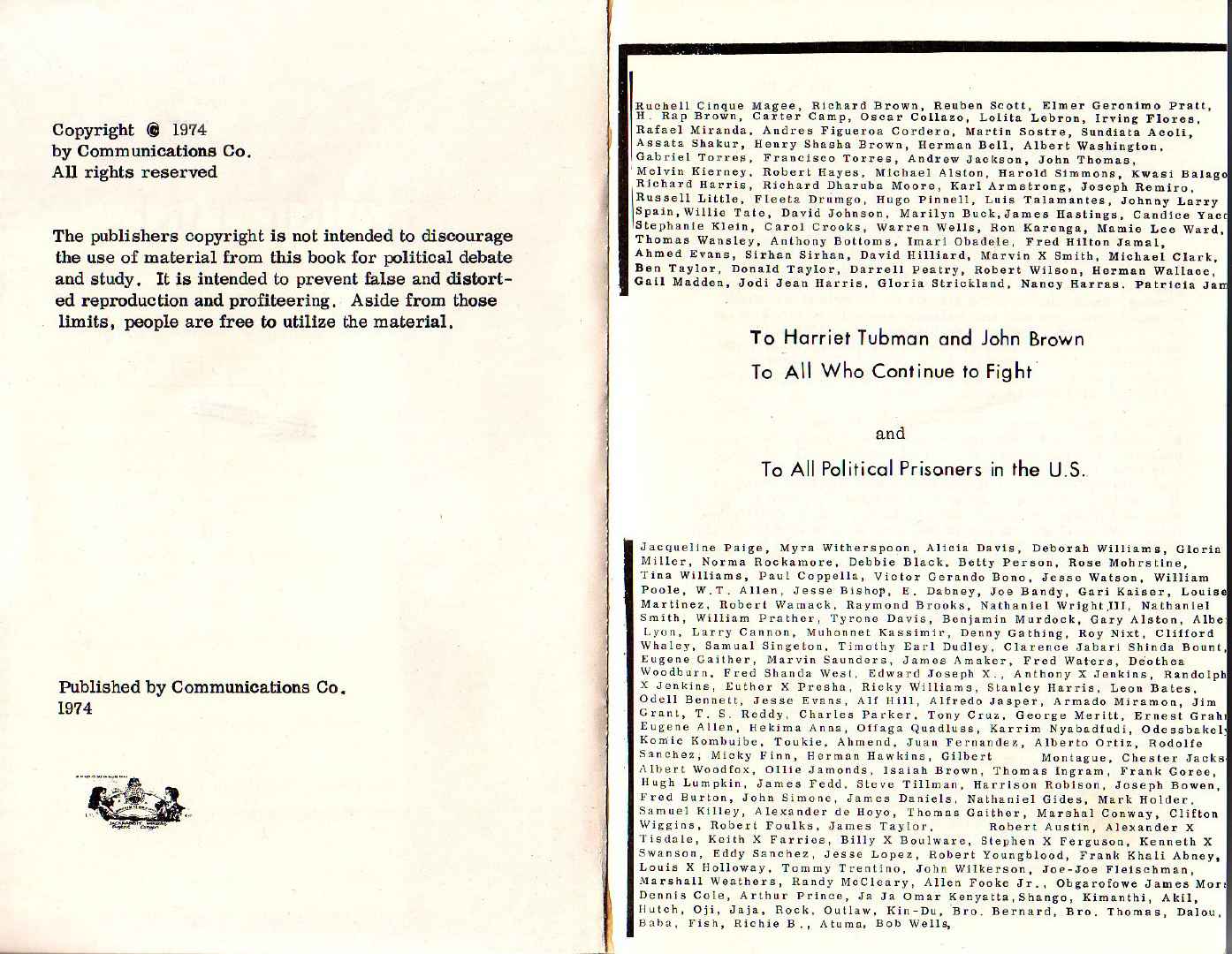


As an aside: Note how, on the copyright page, the authors state that the public is "free to utilize the material" in the book "for political debate and study." That is exactly how it is being used in this essay, though I think it's not quite the kind of debate that William Ayers originally had in mind! Also note that my reproduction of their material, as per their instructions, is true and accurate, and that I am not "profiteering" from it because this site has no ads and does not generate any income whatsoever.

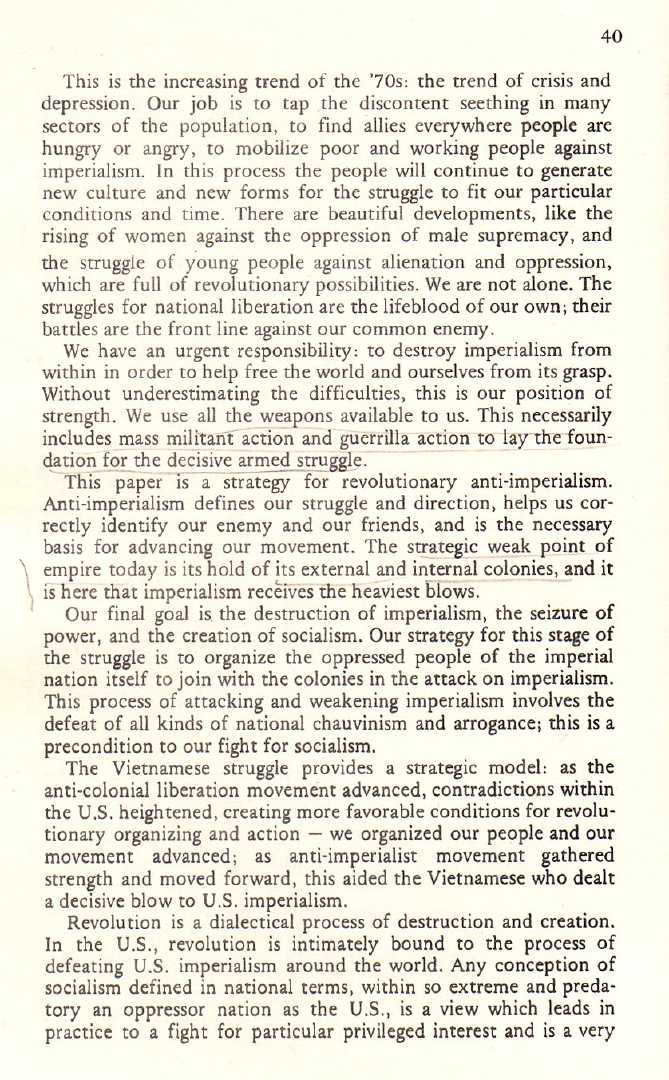
Page 40: Strategies for Revolution

Page 40 of the manuscript is typical: It outlines the Weather Underground's strategies for overthrowing the United States. Among the many strategies are: eliminating the feeling of patriotism among the general public, destroying the government from within, and starting a mass insurrection among the lower classes. The three scanned quotes are followed by a full page 40 with them in context:
Our job is to tap the discontent seething in many sectors of the population, to find allies everywhere people are hungry or angry, to mobilize poor and working people against imperialism.
We have an urgent responsibility: to destroy imperialism from within in order to help free the world and ourselves from its grasp.
Our final goal is the destruction of imperialism, the seizure of power, and the creation of socialism. Our strategy for this stage of the struggle is to organize the oppressed people of the imperial nation itself to join with the colonies in the attack on imperialism. This process of attacking and weakening imperialism involves the defeat of all kinds of national chauvinism and arrogance; this is a precondition to our fight for socialism.


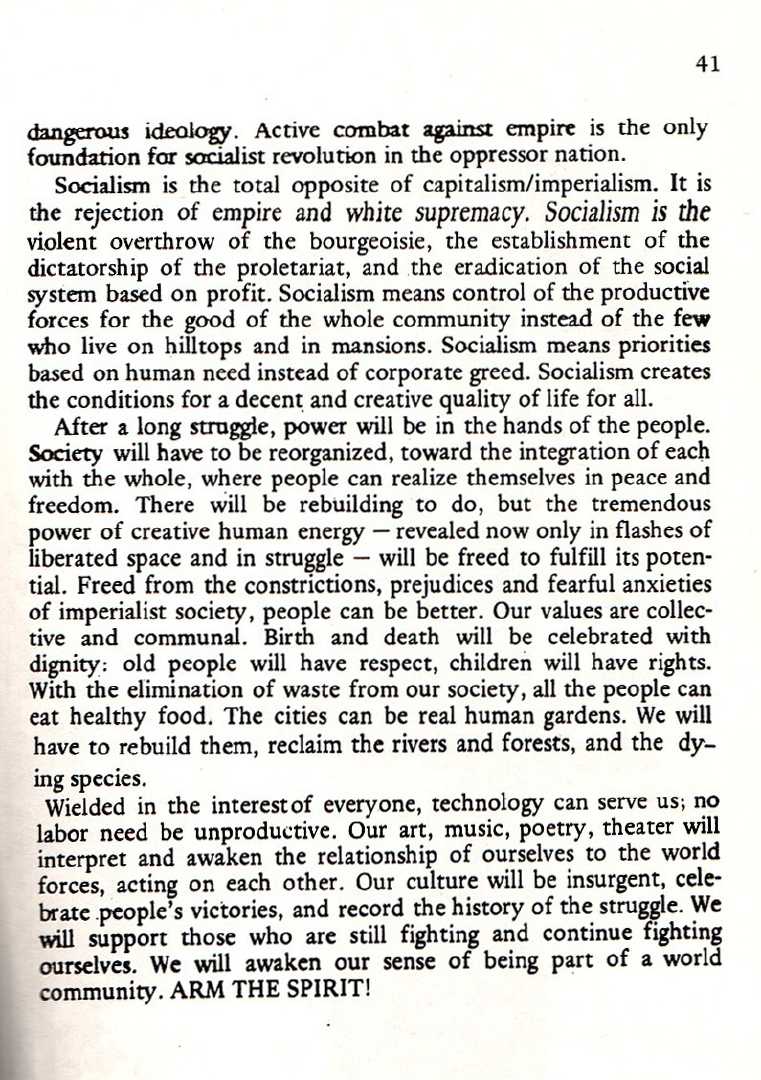
Page 41: The Definition of Socialism

Ever since the word "socialism" was brought up in the campaign by "Joe the Plumber," to whom Obama said he intends to "spread the wealth around," there has been much discussion among pundits about what the word "socialism" really means, and whether or not it's a bad thing.

Well, William Ayers had his own definition of socialism, which he spelled out on page 41 of Prairie Fire. Because it's relevant to current events, let's look at what the word "socialism" meant to left-wingers not too long ago:

(Note: the distortion of the text in the following image was caused by a glitch in the scanner; it was not on the original page.)

Socialism is the total opposite of capitalism/imperialism. It is the rejection of empire and white supremacy. Socialism is the violent overthrow of the bourgeoisie, the establishment of the dictatorship of the proletariat, and the eradication of the social system based on profit. Socialism means control of the productive forces for the good of the whole community instead of the few who live on hilltops and in mansions. Socialism means priorities based on human need instead of corporate greed. Socialism creates the conditions for a decent and creative quality of life for all.
Here's page 41 in full:


Page 13: Vietnam Is Only One Aspect of the Global Communist Revolution

Page 13 discusses how the Vietnam War is only one component of the overall drive for worldwide communism. The following quotes speak for themselves:
We made the choice to become a guerrilla organization at a time when the Vietnamese were fighting a heroic people's war, defeating half a million troops and the most technologically advanced military power. In our own hemisphere Che Guevara urged that we "create two, three, many Vietnams," to destroy U.S. imperialism by cutting it off in the Third World tentacle by tentacle, and opening another front within the U.S. itself. At home, the struggle and insurrection of the Black liberation movement heightened our commitment to fight alongside the determined enemies of the empire.
This defined our international responsibility and our duty as white revolutionaries inside the oppressor nation. We are part of a wave of revolution sparked by the Black liberation struggle, by the death of Che in Bolivia in 1967, and by people's war in Vietnam.

Revolution is a fight by the people for power. It is a changing of power in which existing social and economic relationships are turned upside down. It is a fight for who runs things, in particular, for control by the people of what we communists call the means of production

Here are pages 12 and 13 in high-resolution, showing the above quotes in context; page 12 depicts a Vietnamese peasant woman:


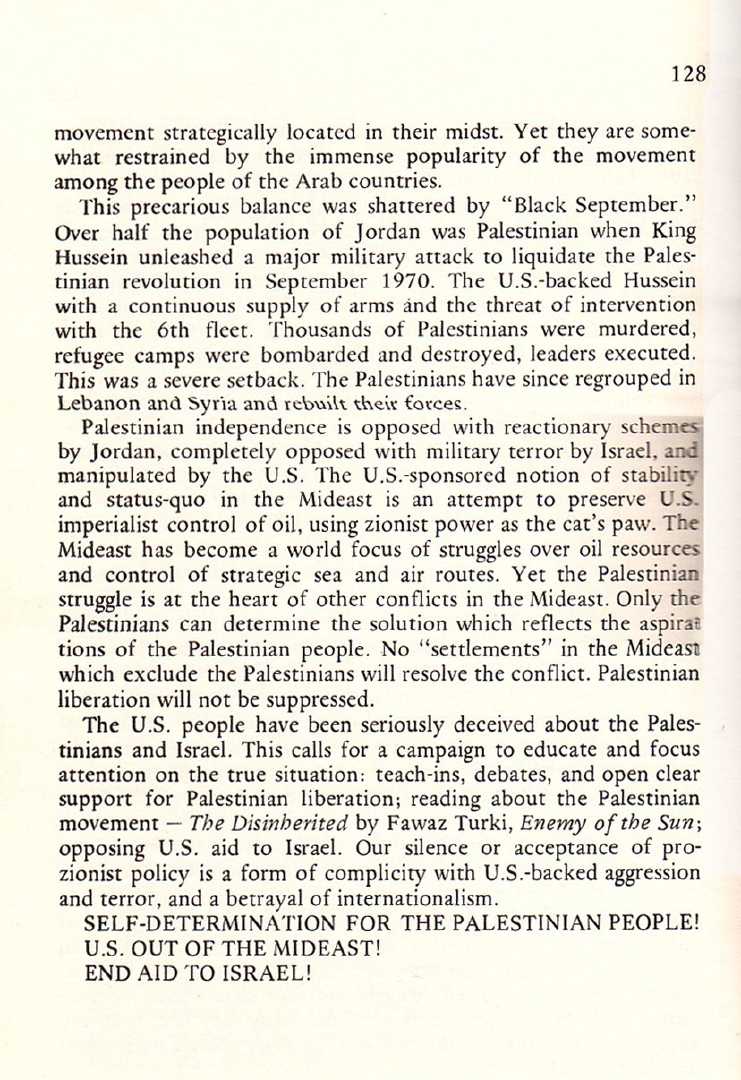
Page 128: Views on Israel, the Palestinians and Mideast Oil

The following quote is taken from page 128, from the portion of Prairie Fire having to do with the Middle East. I include it here to show the amazing consistency of the radical left-wing view of the area -- the issues and arguments remain almost unchanged from 1974 to today: ending Zionism, no "war for oil," stopping U.S. support for Israel, etc. Aside from a few current events details, this exact same text could have appeared in any contemporary left-wing essay about the Middle East. This shows that what once was a radical communist view has now become mainstream:

(Note: the darkened area and the distortions were caused by a glitch in the scanner, and were not part of the original page.)


Here is the entirety of page 128, to put the quote in context:


Ayers' Current Views

At the beginning of this essay, I wrote that William Ayers is a communist. And while I certainly have shown that he was a communist, has he changed his stripes since 1974? Has he ever renounced the ideologies he embraced in Prairie Fire (and elsewhere)?

In short: No. He still maintains the same belief systems. To this day, he sticks to the exact same phraseologies to describe his unchanged political philosophy.

This section explores William Ayers' current beliefs about communist ideology. And why is this relevant? Because if he believed it in 1974, and still believes it in 2008, then he almost certainly continued to believe it in 1995-2006, the period during which Barack Obama had his associations with Ayers. There is no evidence whatsoever that Ayers went through some "right-wing phase" (which would have been totally out of character) nor had any diminuation of his political fervor. As far as anyone can tell, and according to Ayers himself, he has had a consistent and unchanged philosphy from the 1960s up until the present.

What this means is that William Ayers was a communist when Barack Obama associated with him.

So, let's get to the evidence about whether or not Ayers has changed his views.


On April 12, 2002, Ayers said during an interview with a college radio station:
I considered myself partly an anarchist then and consider myself partly an anarchist now. I mean I'm as much an anarchist as I am a Marxist.... I'm very open about what I think and nobody here is surprised by what I think.
...
Is one of those regrets that I took extreme measures against the United States at a time of tremendous crisis? No it is not. I don't regret that. The people of the world are being exploited and oppressed and militarized by the great imperialist powers, led by the United States. That is the situation today in my view.
...
And I'm not sorry about anything that I participated to try to end that war or against that government that was waging that war.
As the video notes, Obama was working directly with Ayers within days of this interview being given -- and for years prior and afterward.

Continuing in the same video, Ayers gave a TV interview in January of 2004 in which he hits on some of the exact same themes and uses some of the same phraseology he used in Prairie Fire:
If we were being fair and open-minded, then if you looked around at the world today, you would say the greatest purveyor of of violence, as King said, is our own government. ...
...
White supremacy and racism continues to be the dagger point of American democracy. I do believe that. I believed it then, I believe it now.
In Prairie Fire, one can find many references to the United States government promoting violence, to white supremacy, and to racism. It's quite obvious nothing has changed in Ayers' philosophy.

Next, let's turn to Bill Ayers' own personal blog, where he posts his own writings.

On April 20, 2006, Ayers posted an open letter in which he wrote:
We were anti-authoritarian, anti-orthodoxy, communist street fighters.
...
I want to embrace...draft resisters, deserters, tax avoiders...
...
If we know we hope to achieve a democratic and socialist world, a culture of life and love, our strategy and tactics are informed by filling that vision out on the ground...
...
I went to Camp Casey in August precisely because I'm an agnostic about how and where the rebellion will break out, but I know I want to be there and I know it will break out...
...
Opposing aggressive war is always urgent, but for revolutionaries we need to both be fully activated in the opposition...
What more need be said?

On November 7, 2006 Ayers posted this essay on his blog describing his visit to a conference in Hugo Chavez's Venezuela -- an essay which sounds like it could be a missing chapter from Prairie Fire, and which Ayers concludes by shouting "Viva Presidente Chavez!"

And just a few months ago on June 28, 2008, Ayers describes himself in this posting on his blog as a "socialist" when it comes to economic policy.

All of this is, of course, just the tip of the iceberg. To this day, nearly every word that Ayers utters and every sentence that he writes hews to the exact same communist line. You can easily find hundreds more examples yourself just by browsing through his blog or simply by Googling his name and searching for his writings and speeches, almost all of which still revolve around notions promulgated in Prairie Fire.

William Ayers is a communist. By his own description. He was a communist then, he is a communist now, and he was a communist for the entire time that Barack Obama worked with him and was associated with him.


Meanwhile, the North Vietnamese communists, whom William Ayers was glorifying and praising, themselves imprisoned and tortured for over five years a young pilot by the name of John McCain. Here's a newly discovered video of McCain taken in January of 1968 as he lay injured in a North Vietnamese prisoner-of-war hospital shortly after his capture. What's heart-rending about it is that he does not yet know that he will spend the next five years being tortured by William Ayers' comrades:


Additional Links

New York Times: Obama and '60s Bomber: A Look Into Crossed Paths

In 2001, the New York Times reviewed Ayers' fictionalized "memoir" Fugitive Days and called it "maddeningly evasive... one of those books that tell by not telling."

Excellent article by David Horowitz about Ayers; the source of the quote in which Ayers describes himself as "Guilty as hell. Free as a bird. America is a great country."


Undercover agent Larry Grathwohl, who had infiltrated and joined the Weather Underground, described their post-revolution governing plans for the United States in this video taken from the 1982 documentary "No Place to Hide." The Weather Underground openly discussed exterminating 25 million Americans who refused to be "re-educated" into communism.

Here's a transcript of his interview:

I bought up the subject of what's going to happen after we take over the government. We, we become responsible, then, for administrating, you know, 250 million people.

And there was no answers. No one had given any thought to economics; how are you going to clothe and feed these people.

The only thing that I could get, was that they expected that the Cubans and the North Vietnamese and Chinese and the Russians would all want to occupy different portions of the United States.

They also believed that their immediate responsibility would be to protect against what they called the counter-revolution. And they felt that this counter-revolution could best be guarded against by creating and establishing re-education centers in the southwest, where we would take all the people who needed to be re-educated into the new way of thinking and teach them... how things were going to be.

I asked, well, what's going to happen to those people that we can't re-educate; that are die-hard capitalists. And the reply was that they'd have to be eliminated. And when I pursued this further, they estimated that they would have to eliminate 25 million people in these re-education centers. And when I say eliminate, I mean kill. 25 million people.

I want you to imagine sitting in a room with 25 people, most of which have graduate degrees from Columbia and other well known educational centers, and hear them figuring out the logistics for the elimination of 25 million people.

And they were dead serious."

-- Larry Grathwohl, former member of the Weather Underground

The Gods of the Copybook Headings

AS I PASS through my incarnations in every age and race,
I make my proper prostrations to the Gods of the Market Place.
Peering through reverent fingers I watch them flourish and fall,
And the Gods of the Copybook Headings, I notice, outlast them all.

We were living in trees when they met us. They showed us each in turn
That Water would certainly wet us, as Fire would certainly burn:
But we found them lacking in Uplift, Vision and Breadth of Mind,
So we left them to teach the Gorillas while we followed the March of Mankind.

We moved as the Spirit listed. They never altered their pace,
Being neither cloud nor wind-borne like the Gods of the Market Place,
But they always caught up with our progress, and presently word would come
That a tribe had been wiped off its icefield, or the lights had gone out in Rome.

With the Hopes that our World is built on they were utterly out of touch,
They denied that the Moon was Stilton; they denied she was even Dutch;
They denied that Wishes were Horses; they denied that a Pig had Wings;
So we worshipped the Gods of the Market Who promised these beautiful things.

When the Cambrian measures were forming, They promised perpetual peace.
They swore, if we gave them our weapons, that the wars of the tribes would cease.
But when we disarmed They sold us and delivered us bound to our foe,
And the Gods of the Copybook Headings said: "Stick to the Devil you know."

On the first Feminian Sandstones we were promised the Fuller Life
(Which started by loving our neighbour and ended by loving his wife)
Till our women had no more children and the men lost reason and faith,
And the Gods of the Copybook Headings said: "The Wages of Sin is Death."

In the Carboniferous Epoch we were promised abundance for all,
By robbing selected Peter to pay for collective Paul;
But, though we had plenty of money, there was nothing our money could buy,
And the Gods of the Copybook Headings said: "If you don't work you die."

Then the Gods of the Market tumbled, and their smooth-tongued wizards withdrew
And the hearts of the meanest were humbled and began to believe it was true
That All is not Gold that Glitters, and Two and Two make Four
And the Gods of the Copybook Headings limped up to explain it once more.

As it will be in the future, it was at the birth of Man
There are only four things certain since Social Progress began.
That the Dog returns to his Vomit and the Sow returns to her Mire,
And the burnt Fool's bandaged finger goes wabbling back to the Fire;

And that after this is accomplished, and the brave new world begins
When all men are paid for existing and no man must pay for his sins,
As surely as Water will wet us, as surely as Fire will burn,
The Gods of the Copybook Headings with terror and slaughter return!

Gasman's Haeckel's Monism and the Birth of Fascist Ideology

Look how little the leopards have lost their spots!

Professor Gasman’s Haeckel’s Monism and the Birth of Fascist Ideology provides insights into the coherent fascist intellectual doctrine that, by 1920, was embraced by a wide swath of European academics and artists. Defining features of this cohort were:

They referred to themselves as: ecologists, naturalists and socio-biologists.
They were pseudo-scientists bent on subverting real science.

Their mantras were: natural, holistic, and organic.

Their Religion of Nature was basically a revival of Pantheism. They worshipped Earth as a divine living organism. Human achievements were disparaged as scant and fleeting compared to Nature’s glory.

They desired scientist-led governance. Scientists probed Nature’s divine realm, hence scientists alone understood the political implications of Nature’s laws.

They were pessimistic and denied the existence of progress.

They exhibited a longing for primitivism.

They were organizationally and ideologically linked to the organic foods movement.

They were organizationally and ideologically allied with the occultist/neo-pagan milieu.

They were divided between those who wanted to replace Christianity and those who wanted to modify Christianity.

They dreaded human overpopulation and were active in eugenics/population control strategizing.

They considered humanitarianism to be scientifically incorrect.

They described society as an organism that grew organically out of Nature.

They saw direct continuity between biological and sociological laws, and contended that bio-evolutionary laws should literally be the basis for human laws.

They believed human survival required abject conformity to the environmental totality. Human liberation would come not through dominion over Nature but through submission to Natural Law.

They opposed capitalist industrialization and sought to reinvigorate beleaguered countryside interests undermined by the rise of industrial cities. Hostility to industrial capitalism manifested in criticism of what was deemed lifeless scientific-mechanical thinking.

They stridently opposed democracy.

Gasman did not set out to expose similarities between environmentalism and fascism. His book makes no reference to environmentalism nor ventures off the topic of European academic trends circa 1870-1920.

TABLE OF CONTENTS


Gasman and History

Gasman’s The Scientific Origins of National Socialism (1971) exposed German zoologist Ernst Haeckel’s role in the rise of Nazism. His sequel, Haeckel’s Monism and the Birth of Fascist Ideology (1991), discusses Haeckel’s contribution to fascism elsewhere in Europe. For the sequel Gasman visited Jena’s Haeckel Haus library, which became accessible after the fall of the Berlin Wall. He discovered a trove of letters to Haeckel from proto-fascist intellectuals.

Gasman’s thesis is that fascism was a coherent intellectual doctrine advocating a scientist-led social transformation. The biological sciences were key factors in fascism’s birth and development. Haeckel provided scientific legitimization for this movement. Fascist intellectual doctrine crystalized before 1919 in a process inseparable from the widespread Haeckelian cultural reformation. Monism, Haeckel’s religion, was a common denominator among various national fascisms. There was obvious Monist content in the thought of Mussolini, Hitler, and Norway’s Quisling and Britain’s Oswald Mosley.

Gasman concludes his introductory chapter with:

“…Fascist ideology was largely a consequence of the direct and specific transformation of a widely held, popular scientific system... This scientifically based ideology, in turn, proved powerful enough to generate a political movement that was able to gain influence and ascendancy in a number of unstable political and social environments, and hence to play a predominant, though not exclusive role in the origins of Fascism. The ideology in question was the evolutionary Monist science and philosophy of the German zoologist Ernst Haeckel...”

Gasman concludes his book thusly:

“Fascism emerged as an expression of the intellectual and cultural forces that had been unleashed by the Monist movement in the decades around the turn of the 20th century… Fascism and its glorification of the power of evil immanence, was only a variation on Haeckelian Monism’s most essential philosophical axioms and scientific, political and religious beliefs.”

Haeckel’s contribution to fascism has been hosed down the memory drain. Gasman explains this ongoing historical lapse, in part, by recalling:

In West Germany a major conference on Haeckel, organized in 1978 by the Association of German Societies for the History of Medicine, gave expression to a widely held opinion in that country, when it set out to run determined interference against the idea that Haeckel, the enlightened, progressive, secular, and above all materialist thinker could be associated with mysticism and the genesis of National Socialism.”

Several ruses conceal Haeckel’s contribution to fascism:

    1. Historians highlight Social Darwinism’s role in fascist ideology. However, fascist ideologues studied Haeckel, not Darwin. When Continental Europeans discussed evolution, they typically regurgitated Haeckel’s quasi-Darwinist theories.
    2. The late 19th century rebellion against Western Civilization and Christianity, ascribed to Nietzsche, should be credited to Haeckel.
    3. Henri Bergson et al. are named as inspiring the fascist precursors: Syndicalism and Futurism. Syndicalist tracts are unmistakably Haeckelian. Futurism was far closer to Haeckel than to Bergson’s moralistic Catholicism, where one finds no aggressive socio-biology or war mongering.
    4. Haeckel is portrayed as a materialist, empiricist, and left-wing progressive. Haeckel was an idealist, mystic, elitist, racist reactionary.
    5. Proto-fascist ideologues who were also Haeckel disciples have either been deleted from history or have had their connection to Haeckel deleted.

Haeckel, Monism, and the Fin de Siècle Zeitgeist

Lamarck introduced biological evolution (“transformism”) in Zoological Philosophy (1809). Darwin improved on Lamarck’s thesis in Origin of the Species (1859). Continental Europe’s salon set preferred Lamarck to Darwin. The “Darwinian” clubs that proliferated across Europe in the late 19th century were mislabelled.

Far more so than in the English-speaking world, on the Continent an extreme reactionary world-view, framed as “Social Darwinist,” gained currency. This process occurred alongside a counter-attack on Comtian positivism (empiricism). Anti-positivism was marked by syncretic mysticism and militant irrationalism. In this milieu “German science” carried the force of law. The era also witnessed the budding of “volkisch” creeds seeking to reinvigorate beleaguered countryside interests undermined by the rise of industrial cities.

Ernst Haeckel was born in 1834 in Potsdam. After receiving a doctorate in zoology (1861) he became Professor of Zoology at the University of Jena in 1862 where, apart from his travels, he lived until his death in 1919. His academic focus was on how eco-systems shaped life-forms (morphs). He coined the word “ecology.”

Haeckel’s cyclical view of history, and consequent denial of linear progress, probably derives from Vico. Haeckel cited Spinoza and Bruno as sources of his pantheism. A lesser-known influence was the French writer Eliphas Levi, who self-described as a materialist and atheist yet cloaked a belief in a mystical “Universal Agent” in scientific jargon – a formula similar to Haeckel’s. More importantly, Haeckel was a product of German Romanticism/German Nature Philosophy. Haeckel was this school’s effort to digest Darwin.

In his famous address to the 38th Congress of German Naturalists (Stettin, 1863) Haeckel presented a manifesto for German evolutionists. German Darwinism would be a cosmic philosophy capable of solving pressing social problems. Haeckel’s Darwinism was a political religion, a cornerstone for a reformation.

Haeckel claimed to believe in Darwinism, i.e. materialistic Natural Selection. In reality, he described an evolutionary process guided by mysterious forces, i.e. an idealistic, Romantic vision nearer Lamarck than Darwin. Haeckel vociferously championed Lamarck. He neither abandoned the belief in ongoing spontaneous generation of life nor the idea of inherited acquired characteristics. His racial theories were exact expressions of Lamarckian processes.

Haeckel’s Darwinism literally provided the basis for social laws. Western Civilization’s defect was its effort to rationally re-construct society divorced from Nature’s laws. Man’s survival dictated conformity to the environmental totality.

Haeckel’s show-piece was “evolutionary recapitulation” (a.k.a. Biogenetic Law, or “ontogeny recapitulates phylogeny”), which asserted that the development of each individual organism repeats, in abbreviated form, the stages of evolution. History dictated the traits of species and races. This theory dominated biological and anthropological science. (Freud’s Oedipus Complex was a recapitulation theory.) Haeckel mentored a generation of leading biologists including the “vitalist” Hans Driesch and the neo-Lamarckian Richard Semon.

Haeckel’s many books were reissued in countless editions. Better known titles were: General Morphology (1866), Natural History of Creation (1868), The Evolution of Man (1874), Perigenesis of the Plastidule (1875), History of the Creation of the Higher Organisms (1877), Cell-Souls and Soul-Cells (1878), Monism as Connecting Science and Religion (1892), Monism as Connecting Science and Religion (1897), The Riddle of the Universe (1899), and God-Nature (1914).

Haeckel drifted toward mysticism. Later tomes contended the universe was alive and that matter had a soul. By 1914 he was penning pantheistic tributes to “immortal germplasm. Despite materialistic posturing, Haeckel became evermore Romantic, anti-Reason, even alchemical and magical. His science subverted science.

Haeckel clung to the label “atheism” while preaching the world was living divinity. Haeckel always stipulated that his “materialism” presumed a matter fused with spirit. He claimed the “Monistic idea of God… recognizes the divine spirit in all things.” He elsewhere said: “God is everywhere.” He spoke of God: “the almighty,” “the single creator,” “the single cause of all things,” “the absolute,” and “the sum of all matter and energy.

In the 1870s, as Haeckel emerged as a Europe-wide celebrity, he focused on the socio-biology of human races. As early as 1868 he praised Sparta’s ruthless eugenics. He contended each race possessed a spirit. By 1877 he was unequivocally pushing a science-cloaked doctrine of Aryan supremacy.

During the 1870s Haeckel included into his religion, Monism, the tenet that because Nature was inherently aristocratic, then all forms of egalitarianism and democracy violated biological laws.

Haeckel’s voyages to the tropics spawned a longing for primitivism. He described tribal peoples as admirable uncivilized collectivities. Through Haeckel, the “noble savage” became the “anthropological savage.”

Before the turn of the century, a major German publisher, Eugen Diederichs, devoted himself to distributing the works of Haeckel and his followers. Diederichs moved to Jena.

Haeckel’s The Riddle of the Universe (1899) became an immediate international best-seller. The book claimed Jesus was the offspring of an illicit liaison between Mary and a Greek Centurion. Christ was an Aryan. The book denounced the spiritual tyranny of the Papacy and lauded the pantheism of Bruno. The Riddle deified “psychoplasm.”

In 1904 Haeckel was guest speaker at the International Freethinkers Congress in Rome. In the same year he chaired a competition, funded by Friedrich Krupp, to select the best eugenics text. Capitalizing on his immense popularity, Haeckel proposed chartering a Monist church. Two years later (1906) the German Monist League was launched. The scientific salons of the Monist League attracted Berlin, Vienna, and Zurich’s high society.

German Monist League President, Nobel Prize winner Wilhelm Ostwald, formulated his own spiritual theory – Energetics. This rhetorical flourish proved a central motif for fascist philosophes obsessed with the enigma of energy.

Fellow League leader, Wilhelm Boelsche (Haeckel’s biographer) wrote a best-selling Monist-inspired work on sex among wild animals. Boelsche launched his own cult of Eros/Agape.

Another League notable, Nobel Prize winner Svante Arrhenius, popularized the concept of life on Earth arising from spores (panspermia) wafting in from outer space.

By his 80th birthday (1914) Haeckel had been granted honorific membership in 100 European professional and scientific societies.

*

Monism meant “mono-ness” or “oneness.” Monists preached the oneness of spirit and matter; the oneness of the organic and inorganic; the oneness of Man and Nature. Talk of “holistic” and “organic” mesmerized Germans.

Christianity had to be replaced because it was “dualist,” i.e. it separated spirit from matter, God from Man. Descartes, the “pupil of the Jesuits,” was likewise denounced for his dualist philosophy. Dualism and its brood of mechanical sciences and nefarious industrial creations alienated Man from his Natural environment. Liberation would come not in dominion over Nature but in submission to Nature. Man’s achievements were scant compared to Nature’s glory. Monism re-united Man with Nature.

Monists disputed linear progress. They believed in cyclical undulating evolution. They emphasized brute force and raw instinct. Natural Laws determined human existence and had to be obeyed. Humanitarianism was “scientifically incorrect”. Universal rights were a French Revolutionary myth. They stridently denounced parliamentary democracy and craved a hierarchical-centralized world – cardinal principles of fascism.

Monists pushed racism, anti-Semitism, eugenics, and euthanasia. Germans (Aryans) were the top rung of the evolutionary ladder. Haeckel contended the hereditary gap between German high society and primitive African tribes was greater than the hereditary gap between those tribes and apes. Monists deemed Asian population growth a mortal threat.

Monists blamed Jews for imposing monotheism onto Europe. Jews were viewed as a source of decadence and morbidity. Jews symbolized Man’s rebellion against Nature. Haeckel advocated the immediate exclusion of Jews from contemporary social life.

The German Monist League became a clearing house for eugenics proposals. Haeckel’s legion fostered Germany’s eugenics policies.

During WWI the journal of the Monist League, and Haeckel’s Eternity (1915), espoused a militaristic bellicosity plainly presaging Nazism. Haeckel was a founder of the imperialist Pan-German League.

Monists adhered to the zeitgeist’s pervasive pessimism. Europe had been declining since Christianity began suppressing creative instincts. Haeckel preached this before and after Nietzsche.

Monists veered toward spiritualism in the 1890s, especially in Germany and Scandinavia. They spoke of the world as a breathing organism. They worshipped Nature as a divinity. This was part of a trend wherein persons of religious sensibility incapable of remaining Christian embraced all manner of supernatural products: Theosophy, occultism, magic, Kabala speculations, Neo-Platonist ravings. Antiquated debris of every kind, heaped haphazardly, returned in defiance of common sense.

Monists facilitated the astonishing recrudescence of Bruno’s hermeticism as a viable intellectual tradition. Hermeticism and Monism were near identical doctrines. Both worshipped “Pan” and the “All in the All.” Edouard Schure, the most popular French hermetic, praised Haeckel. His The Great Initiates declared Monism to be the point of departure for modern science and art. Monist evocation of hermetic sun worship portended many fascist rituals.

Monists venerated Renaissance alchemists as forbearers. The alchemists’ belief in a prima material imbued with godliness was not far from Haeckel’s “matter-spirit-universal-ether.” Haeckel’s “ontogeny recapitulates phylogeny” resembles alchemy’s “microcosm and macrocosm” and “as above so below.” Renaissance notions of the Eternal Return driven by divine, irrational forces resemble Haeckel’s cyclical evolutionary theory.

The magical cult of Theosophy appealed to Monists seeking scientific rationales to validate their anti-science inclinations. Haeckel encouraged theosophical groups and freely admitted to having been correctly described by Theosophists.

In identical language Monists and Theosophists offered their pseudo-scientific religion as a replacement for “dead” Christianity to heal a Europe torn asunder by the triumph of lifeless scientific-mechanical thinking. After 1900 the two currents merged. Their brand of spiritualism became a fascist trademark.

Theosophist high priestess Mme Blavatsky’s famous The Secret Doctrine is a Haeckelian tract filled with reverence for the mystical “one homogenous substance.” Annie Besant, another leading Theosophist, was a Haeckel acolyte. The English translation of arch-Haeckelian Jules Soury’s Religion of Israel was published by Besant’s London-based society. French Theosophist Jules Lermina’s The Occult Science opened with a tribute to Haeckel’s genius.
Avant-garde artists, Modernists, were subject to Monism’s overpowering prestige. Modernists attacked “bourgeois” liberalism and championed the aristocratic nature of art. Art Nouveau paintings were Monist logos. Art Nouveau’s main journal was edited by a prominent Monist.

Monism played a monumental role in stimulating German avant-garde painters. Berlin’s Dada guru dedicated his most famous painting to Haeckel. The Blue Rider clique emphasized: pantheism, apocalypticism, primitivism, and the Earth-idea. The Blue Rider leader (and founder of Abstract Expressionism) stressed the “organic bond with nature” and the “biological paradigm.” He worked from Haeckel’s illustrations, particularly his drawings of “invertebrate denizens of the deep.” Another Blue Rider worked exclusively from Haeckel’s sketches, particularly of his famous crude radial flowers. Haeckel gloated about how his sketches launched “a new aesthetic sense.”

Matisse’s patron, French parliamentarian Marcel Sembat, was a Monist League founder who led the French delegation to the First International Monist Congress (Hamburg, 1911). Matisse was a Vichy sympathizer.

Gauguin’s world-view was grounded in books by Theosophist Gerald Massey, translated and prefaced by Soury. Gauguin’s Noa Noa denounces “dualism” and praises primitive cosmology. Veneration for primitive cultures was a Monist-Modernist intersection. The magical primitivism of Picasso can be linked to Monism.

Monist-inspired authors include: Franz Kafka, Hermann Hesse, Jack London, Thomas Mann, and Thomas Hardy.

Haeckel's Austrian and French Disciples

Austrian anthroposophist guru Rudolf Steiner met privately with Haeckel and the two maintained a decades-long correspondence. Steiner’s books and articles lauded Haeckel as one of the greatest thinkers of all time. Steiner’s followers treated Haeckel’s The Riddle like a bible.

After 1890 Monists gravitated to Steiner. Members of both cults joined the Bruno Bund. Haeckel distanced himself from Steiner who, unlike Haeckel, openly affirmed his mysticism rather than concealing it beneath a scientific veneer. Affinities and contacts between Monists and Steinerites survived well into the 20th century.

Austrian sociologist Gustav Ratzenhofer (1842-1904) was a German Monist League hero. His sociology was pure Monism. In texts published in 1893 and 1899 Ratzenhofer: attacked liberalism, reduced justice to brute force, and described peace as a time to prepare for war. He obsessed over a spiritual energy, “Urkraft,” which he claimed was scientifically validated.

Ratzenhofer considered aristocracy to be natural. The masses, left to their own devices, would bring on their own physical and moral decline. Talk of gender equality was “insanity.”

Ratzenhofer considered race war to be natural. He was an anti-Semite. He opposed race-mixing and claimed Lapps, Gypsies, and other un-civilizable races should be removed from social life. He pioneered the ultra-nationalist volkisch creed about the geographical rootedness of biological races. He prophesized the coming of a Fuhrer.

General Ratzenhofer was Chief of Austria’s Military High Court.

Jules Soury’s (1842-1915) intellect was shaped by his long affiliation with Haeckel. His correspondence with Haeckel ran from 1878 to 1914. He was Haeckel’s spokesman par excellence. He translated a number of Haeckel’s works into French and generated a torrent of his own Monist books and lectures.

Soury described Haeckel as: “the illustrious scientist,” “the celebrated naturalist,” and “the daring genius.” Soury’s four-volume opus (1877 to 1882) claimed Haeckel’s ideas were superior to all others in history. He claimed Haeckel inspired “most of the scientific books that were being published in Europe.” The series ended in a 30-page ode to Haeckel’s unparalleled, epoch-making achievements.

Upon the release of Haeckel’s Monism as Connecting Science and Religion (1892), Soury expressed disquiet over the book’s religious tenor. “I cannot follow you onto this terrain,” opined Soury. However, Soury soon followed and his adulation grew.

Soury: opposed liberalism and democracy, supported physiological determinism, viewed evolution as blind and purposeless, and contended Christ was an Aryan.

As a founder of the ultra-right French Action group, and as a mentor to leading French reactionaries, Soury was an architect of French fascism. He also profoundly influenced the Parisian art scene.

While Soury preached Monism, he wanted to preserve French Catholicism. Two titans of French fascism, Barres and Maurras, shared Soury’s rejection of religious Catholicism in favour of Catholicism’s historic-racial roots. They wanted a de-Semitized Catholicism. “If you desire to be an atheist,” Soury declared, “then be Catholic in France.”

Soury’s Nationalist Campaign (1902) is the prequel of Hitler’s Mein Kampf wherein Soury proudly describes himself as an anti-Semite. France was divided between Aryans and Jews. The latter posed a religious and racial danger to the former. Judaism was a “racial fact,” not a theology. The worship of the Hebrew God undermined Aryan mental health. The book explicitly argues that saving the Aryan race required destroying the Jewish race. Soury based this conclusion on scientific arguments. The book leans on Haeckel’s scientific authority ad nauseam, with numerous references to Biogenetic Law and the biological character of races.

Georges Vacher de Lapouge (1854-1936) was a long-time champion of Monism who, as late as 1934, boasted of being Haeckel’s personal collaborator. The two men exchanged letters for over 30 years. In an 1888 letter Vacher de Lapouge confided:

A great part of my theory is in effect immediately dependent upon your doctrine…”
In an 1896 letter Vacher de Lapouge discussed how his Monist lectures at the University of Montpellier provoked such uproar that his course was cancelled and he was demoted to librarian.

Vacher de Lapouge translated two of Haeckel’s books, penning prefaces for both.

Vacher de Lapouge denounced Catholic opposition to Monist evolutionary ideas. He prophesied a new spiritual age wherein “the confession of Haeckel” – the indestructible Religion of Nature – would be Man’s central faith. Vacher de Lapouge:

I associate myself with the great naturalist (Haeckel) in professing the supreme monist dogma: God is everything, in all, all over. He is eternal. He is infinite.”

In Vacher de Lapouge’s vision, scientists would be politicians. As scientists probed Nature’s divine realm, they alone understood the political implications of Nature’s laws. Scientists were God’s avatars.

He repudiated French Revolutionary ideals. “Determinism, inequality, and selection” vanquished “liberty, fraternity, and equality.”

Vacher de Lapouge was an anti-Semite and Aryan supremacist. History was driven by racial inequality. Aryans were a precious ferment whose exhaustion marked the end of civilization. Democracy was a racial tragedy. He advocated exterminating inferior races.

Vacher de Lapouge’s memory was honoured by the Third Reich and the Vichy regime. He was a celebrated figure in the Pantheon of fascist prophets.

While Gustave Le Bon (1841-1931) is remembered as a Darwinist, he was a Haeckelian. Under the pressures of WWI Le Bon did denounce Haeckel’s premise of continuity between biological and sociological law. However until that time, he was a dedicated Monist. Le Bon believed in: physiological determinism, materio-vitalism, collective racial souls, and undulating evolutionary cycles.

Le Bon came to Paris to study medicine and biology in the 1860s when evolution was the rage. His mentor was a Haeckel confidante who translated Haeckel’s articles while presiding over the French Anthropological Society. Le Bon was also close to Monist League co-founder Charles Richet, editor of the Scientific Review.

Le Bon achieved fame in the 1880s with his two-volume Man and Societies. These paraphrases of Haeckel advocated: determinism, spiritualism, Lamarckianism, and defended Haeckel’s racism with quotes from Haeckel. In Lamarckian fashion, Le Bon contended America’s white population were becoming “redskins” due to environmental factors.

Le Bon’s The Psychology of Crowds (1894) relied entirely on Monist principles. The irrationality of common people necessitated elites. Le Bon saw an ethereal mental vibration in crowds; a collective unconscious – ideas that became guiding lights for fascist dictators.

Le Bon’s Psychology of Socialism (1899) denounced egalitarian creeds (liberal, democratic, and socialist) as violations of Natural Law. The masses were biologically inferior to upper classes; hence, there was urgent need to suppress democracy.

Robert Michels’ career began in 1901 with a publication in a Monist journal. The sociology texts he wrote between 1911 and 1914 reflected the prevailing Haeckelianism. He singled out Haeckel as a “completely correct” thinker who elevated sociology to a science. Elsewhere, Michels wrote approvingly of Monist-inspired thinkers, Monist evolutionary theory, and the organic nature of society.

In 1912, at the First International Eugenics Congress, Michels declared his fundamental thesis to be the iron law of oligarchy. This paralleled Haeckel’s aristocratic assumptions.

Michels considered eugenics the pressing issue for science. He was an avid morphologist. After studying eye color, hair color, nose shape, skeletal construction and facial muscles, he concluded each social class had a unique physiognomy. The feudal aristocracy were in biological decay because they permitted lower classes to penetrate their ranks.

Michels considered biology to the discipline closest to economics. Moreover, physiological determinism, not classical economics, explained class differentiation. The indigent condition of the working class resulted from workers being genetically inferior. Egalitarians were fools. The future belonged to biological elites.

When George Sorel (1847-1922) began his intellectual journey writing for a French Marxist journal in the 1890s, he already possessed an intimate knowledge of Haeckel’s works and activities. Sorel argued Marxism would remain viable only if it squared its doctrines with biology. He wrote favourable reviews of Vacher de Lapouge and Le Bon, finding much truth in the former’s “radical Social Darwinism.”

In his The Socialist Future of the Syndicates (1898) Sorel purged socialism of utopianism and egalitarianism. Capitalism would not be overthrown. The task was to facilitate society’s undulating evolution with worker syndicates. “Society” meant the national-racial community. Syndicates would be formed by biologically elite workers. Ordinary workers would be excluded because absorbing weaklings would weaken the syndicate. Sorel rejected quantitative numerical democracy.

(From its turn-of-the-century origin, the European syndicalist movement sought to steer socialism away from economic determinism toward biological determinism. Partly because syndicalists rarely cited Haeckel, historians view Marx, Proudhon, Bergson, and Saint-Simon as syndicalism’s inspiration. However the syndicalist canon reveals Haeckel to be their dominant influence.)

Sorel clung to his Marxist identity but selected only passages from Marx adaptable to Haeckelianism. He sought to unite science and philosophy and found a living party of organic science. He completely identified with Ferri’s formulation that socialism meant unleashing Darwinism.

Sorel wrote influential essays between 1906 and 1908 for the journal Socialist Movement. His Reflections on Violence glorified irrational myths as vital social bonds. Myths were unconscious truths embodied in evolutionary law. The working class’s myth was the general strike. Sorel:

A myth cannot be refuted since it is, at bottom, identical with the conviction of a group...”

A footnote to this essay asserts Haeckel’s Biogenetic Law was so well known it was pointless to discuss its obvious value as an analytical tool. Sorel thus conformed to the general trend that accepted Haeckelian science as axiomatic, therefore not needing citation.

Sorel’s morality mirrored Haeckel’s moral relativism. Naïve human morality conflicted with “the evolution of organic life.” Instinct over-powered Reason.

Sorel praised Haeckel for not hiding the link between evolutionism and theodicy and for arguing that:

“…a more noble idea of God be created, like the one which has inspired the pantheistic philosophers.

As he retreated from Marxism, Sorel increasingly described the revolution in organic, mystical terms. Revolution came to mean converting workers to the evolutionary religion.

Haeckel and Italian Fascism

Haeckel guided a multiplicity of Italian individuals and organizations for 50 years. A substantial number of Italian academic journals adhered to Haeckelianism. Haeckel’s prestige eclipsed Darwin’s. His influence on Italian socialism exceeded Marx’s.

*

Although he did not use the word “Monism” Vilfredo Pareto’s (1848-1923) writings bear unmistakable Monist features such as: a) Nature is the basis for social laws; b) Christianity is harmful; c) science proves social inequality is natural; d) free will is a myth; e) evolution is cyclical; and f) “Social Darwinism” is a well-ordered doctrine.

Pareto’s mentors were Ratzenhofer, Le Bon, Vacher de Lapouge, etc.

Pareto’s famous The Mind and Society (1916) is a rendition of Haeckel’s The Riddle. The book is written from a physiological determinist vantage point and extols Biogenetic Law.

Pareto called democracy “evil.” He opined:

The least we can do is to divide society into two strata: a higher stratum which usually contains the rulers, and a lower stratum, which usually contains the ruled.”

Pareto castigated liberalism as a bourgeois illusion leading to lawlessness. He shouted:

The rising enemies of liberalism need not hide their hand any more” (because) “syndicalism is here and now giving us an insight into what is likely to be the strength and dignity of the new elite.”

To Pareto, eugenics was a racial issue. Europe was threatened by alien races. Humanitarians only protected weak, ill-adapted race-rejects. Pareto’s hope that the peasantry would provide genetic material for future elites anticipated fascism’s fawning over rural classes.

*

Throughout the 19th century “positivism” dominated Italy’s non-clerical intelligentsia. After 1870, due to Haeckelianism’s infiltration of Italian academia, the main branch of Italian positivism lost the traits of traditional positivism (empiricism, materialism, humanitarianism, and enthusiasm for progress). Italian positivists clung to the label “positivism” while reinventing its content. They deployed the theological concepts traditional positivists had dismissed as naïve. They replaced positivist tenets with Monist ones. Italian positivism preserved an undeserved reputation as a materialist, liberal, progressive doctrine. The Fascist state placed the “positivist” misnomer on regressive policies pertaining to population, policing, health, education, and ecology.

Italy’s chief positivist journal, Scientific Philosophy Review, was launched in 1880 by Enrico Morselli (1852-1929). The journal was committed to Haeckel, not Comte. Morselli rebelled against Comtian positivism for being incompatible with spiritualism and overly reliant on materialism. The journal was Italy’s counterpart to Haeckel’s Kosmos. After the journal’s demise in 1891, Morselli founded Review of Sociology – Italy’s chief sociology journal.

Morselli taught psychiatry at the University of Genoa and ran the Royal Asylum for the Insane (Genoa). He founded, and for 50 years led, the main Italian positivist organization. He authored a plethora of books on anthropology and biology. His General Anthropology (1911) became a standard textbook.

While boasting trendy “social-anarchist” and later “syndicalist” affiliations, Morselli was a reactionary. He reverted to biological explanations of social problems, and he denigrated Western humanistic and rational traditions. In 1890 he co-founded the Dante Alighieri Society whose declared intention was an Italian Mediterranean empire. This Society was the Italian counterpart to the Pan-German League.

Morselli’s adulatory letters to Haeckel reveal his devotion to his “illustrious and dear master.” An 1882 letter describes “the harsh struggle that we have to wage in Italy on behalf of the monist doctrine.” The struggle was not in vain as many of Italy’s most studious youth were being converted. He begged Haeckel for written materials. Similar letters followed for decades.

Morselli published a laudatory essay celebrating the 8th edition of Haeckel’s Natural History of Creation. Morselli’s lengthy introduction to the Italian translation of The Riddle exposed a decidedly non-positivist commitment to spiritualism and idealism and uncannily anticipated the flights of rhetorical fancy characteristic of the Mussolini era.

Morselli’s Animal Magnetism (1886) postulated the existence of bio-magnetic forces and related paranormal phenomena – theories akin to Anton Mesmer’s 18th century occultism. Dr. Morselli prescribed magnetic balancing as medicine.

Morselli elsewhere injected occultism and spiritualism into the corpus of positivism. He revived an interest the 15th century alchemist Paracelsus, and he praised the pantheism of Giordano Bruno. He complained Italians found it difficult to embrace the “pantheistic God.”

Morselli proffered an Italian version of volkisch ideology, and he proposed eugenics ideals for Italians (whom he deemed Aryans). Morselli’s fatalism and his positive view of suicide presaged the fascist’s steely indifference to death.
In 1900 Morselli and Roberto Assagioli co-founded the Psyche journal. Assagioli became a top Fascist spokesman.

Under Fascism, until his 1929 death, Morselli’s career continued uninterrupted. He praised Haeckel in his final publications.

Morselli’s co-editor on Scientific Philosophy Review, Giuseppe Sergi (1841-1936), was: founder-President of the Rome Anthropological Society, editor of Anthropological Review, and contributing editor of Sociological Review.

The “syndicalist-fascist” Sergi was a proud follower of Haeckel. A 1904 letter to his “illustrious master” described seeing Haeckel in Rome as “the event of a lifetime.”

Sergi tempered his enthusiasm for Haeckel because Sergi believed Italians to be a race separate from, and superior to, Germans. He arrived at such views by measuring thousands of skulls.

Sergi’s address to the 1912 International Congress of Eugenics stressed the overlay between biology and politics and how physiology was the key. Extensive analysis of craniums, skeletons, skin color, iris color, and hair texture convinced Sergi races were fixed biological entities. He believed racial intermingling led to sterility. He quoted, Fritz Lenz, the future Nazi eugenicist. Sergi used racism to justify Italian domination of the Mediterranean.

Another Scientific Philosophy Review editor,Roberto Ardigo (1828-1920), was the most distinguished Italian positivist. In 1863 Ardigo was the devout Catholic canon of the Cathedral of Mantua. In an 1869 discourse on Renaissance Catholicism, Ardigo outed himself as a Monist. In 1870 he left the church to teach at Mantua Lyceum. By 1881 he was Dean of Philosophical History at the University of Padua, a position he held until his 1909 retirement.

While Ardigo’s Positivist Morality and Sociology maintained a pretense of scientific rigour, his mantra “the indistinct” (“the unknowable”) was unmistakably Haeckelian. He claimed a literal continuity existed between Nature’s laws and sociological laws. Society was a Natural organism. The social body grew organically out of the Natural body. He rejected liberalism and human rights. Ardigo’s texts acquired “must-read” reputations in Italy.

Before his death, Ardigo anointed Mussolini as Italy’s rising intellectual star.

*

The Italian Socialist Party (ISP, est. 1892) was captivated by positivism’s scientific veneer. A sizable right-wing ISP faction revised Marxism to jibe with modern biology. A left-wing faction remained committed to economics and dialectical materialism. Even much of this left-wing ultimately embraced Haeckelian positivism and then went over to Fascism.

ISP potentate and criminologist Enrico Ferri was a physiological determinist. His Socialism and Modern Science (1895), although subtitled “Darwin, Marx and Spencer,” made only scattered references to these thinkers while discussing Haeckel in depth. Ferri claimed: a) Nature moved in meaningless cycles; b) Christianity frustrated Natural Selection; c) elites were necessary; and d) women were scientifically proven to be inferior.

In 1902 Ferri became editor of Italy’s leading Marxist newspaper, Avanti!, and he founded the journal Il Socialismo. (For the latter achievement he received congrats from French Monist Charles Richet.) Il Socialismo was sympathetic to Pareto. One frequent Il Socialismo contributor, Alfredo Nicefero, became a leading Fascist ideologue. Another Il Socialismo writer,Paolo Orano, infused spiritualism into socialism in a long series of articles arguing that biologically unique, instinct-driven social classes drove history. Individualism benefitted only businessmen. Socio-biology overrode egalitarianism.

Ferri rejected emancipation and equality as biologically impossible. By reformulating Marxism in accordance with Monism, particularly its natural aristocracy theory, Ferri presaged Fascist corporatism. Ferri’s “socialism” was a somber feudal-like destiny founded on obligatory labour and committed to eugenics. Ferri and many of his ISP comrades became enthusiastic Mussolini supporters.

*

Giovanni Papini’s first visit to a library was to fetch a biography of Darwin by an Italian positivist. By 1900 proselytizing Monism was the focus of the youthful Papini’s life.

En route to what would become a successful literary career, Papini rejected the positivist branch of Monism as too stultifying and passive. He continued to apply Monist principles, albeit infused with more mystic-idealist content. He advocated a free play of non-rational instinct and claimed all puny accomplishments of Reason would dissolve in Nature. He rejected Christianity (“old rabbit-hearted Nazarenism”) in favour of a new religion synthesizing science and mysticism to cure Italians’ alienation.

In 1903 Papini helped found the journal Leonardo, and he became an editor of the ultra-nationalist journal Il Regno. His 1904 essay “We Are Reactionaries” declared democracy and socialism to be ideologies of the bourgeois enemy. Politics should be restricted to biological elites. Parliamentary democracy divided and weakened Italy.

His autobiography denounced the working class as “stupid, impotent, and incompetent.” He called for nationalism and armament. His sermons about “the spirit” anticipated Fascist refrains about “the will.”

Papini descended into ancient superstitions and frankly magical pursuits. His passages on historical cycles of redemption drew heavily from Goethe.

In 1913 Papini and various Modernist artists (including Futurists) launched the journal Lacerba, whose motifs were relativism, irrationalism, and elitism. The Futurists invigorated Papini’s Florentine circle with militant Monism. Modernists who welcomed Fascism were Haeckel disciples, especially the Futurists, whose unscrupulous Social Darwinism dovetailed with the Fascist party line.

Filippo Marinetti’s Futurist Manifesto was a statement of radical Haeckelianism. Progress demanded cruelty, injustice, and might. War was a means toward biological improvement. Marinetti committed himself unwaveringly to Mussolini.

*

During Mussolini’s childhood Haeckelianism was a prevalent world-view. He was assigned Ardigo’s Positivist Morality as a young student, and he was versed in Haeckelian anti-clericalism.

While still a young man, Mussolini was recruited into Ferri’s “socialist” circle. Under Ferri’s guidance, Mussolini wrote the essay, Man and God (1904) – a faithful paraphrase, if not plagiarism, of Haeckel’s The Riddle. In a 1909 Avanti! article Mussolini celebrated the centenary of Darwin’s birth.

Mussolini denounced “dualism.” He described the organic spirit of inorganic matter. In discussing race, he painstakingly adhered to Haeckel’s lines of argument. Socialism was a cultural revolution aimed at Monist goals. “Darwinism” was the culmination of history.

During WWI, as Mussolini divested himself of Marxism, Haeckelian clichés – hierarchy, race, and struggle – became his catchphrases.

During and after his rise to power, Haeckelian dogma guided Mussolini, albeit not exclusively. His phraseology remained replete with: “matter and spirit,” “the struggle,” and “the naturalness of aristocracy.” Nations had souls rooted in the soil. He condemned democracy and praised the Latin race. On the eve of his March on Rome (October 1922) Mussolini still claimed to be a syndicalist.

In 1929 Mussolini claimed Christianity was born in Palestine but became Catholic in Rome; adding that had Christianity not come to Rome it would have disappeared. (Haeckel said exactly the same.)

A prominent contributor to Mussolini’s personal journal, Gerarchia, wrote about the continuity between biological and sociological laws and emphasized spiritual politics. He claimed Fascism was an expression of Biogenetic Law. A contributing editor for Gerachia in his 1929 obituary for Morselli dubbed Morselli Italy’s greatest disciple of “il Nostro Haeckel,” going as far as saying Morselli’s erudition rivalled Haeckel’s. Frequent contributors to Gerachia’s science section were renowned Haeckelian physiologists. Another contributor, and state official, dwelled on organicism and transformism while describing Fascism as a scientific discipline.

Mussolini’s demographic-eugenics policy wonk, Corrado Gini, achieved fame for his address at the Monist-inspired First International Eugenics Conference (London, 1912). Fascist eugenics policies in general were championed by a circle of Nazi-like theoreticians among whom Haeckel’s physiological determinism and biological racism were standard.

Conclusion

Haeckel coined the word “ecology” and founded the always-political, value-laden, pseudo-scientific scholastic discipline of Ecology. This academic genus operates under the names: Conservation Biology, Human Ecology, Ethno-Botany, etc. and is never far from activism and controversy. Haeckel performed the same sort of focal ideological function in the fascist movement that Marx performed in the revolutionary socialist movement. The ecological movement broadly overlaps with the environmental movement.

Here are four illustrations of the contiguous development of these integrated movements:

  1. The Ecological Society of America (est. 1915) changes its name to the Ecologists Union in 1946 and then to The Nature Conservancy (TNC) in 1951. In 2011 TNC had revenues of $1.2 billion and owned land assets valued at $6 billion.
  2. The American Eugenics Society was founded in 1921 by several of America’s wealthiest men. The Society was racist and classist and advocated involuntary sterilization. The Society was renamed the Society for the Study of Social Biology in 1970s, but before that key members and funders of the Society built up the Planned Parenthood Federation of America (PPFA, est. 1941). PPFA uses its $1 billion in annual revenues to run 820 clinics that provide abortion/contraceptive services to low-income Americans. PPFA founded and leads International Planned Parenthood Federation, which uses its $125 million annual budget to run clinics in developing countries.
  3. The followers of the Monist sibling cult of Rudolf Steiner are now known as Anthroposophists. They operate over 10,000 commercial enterprises (organic farms, homeopathic clinics, and Waldorf schools) – green businesses all.
  4. Diederichs Publishing, which flogged Haeckel’s books, is now a subsidiary of the Bertelsmann media conglomerate (world’s largest book publisher), an enterprise easily connected to both Nazism and environmentalism.

Nature has many meanings. Nature can mean wilderness, as in an area of undeveloped land populated with wild animals and plants. Keeping tracts in a natural state is a land-use strategy critical in maintaining high land values, rents, and agricultural prices. Nature can also mean the inherent quality of a thing. Inheritors justify their wealth by pointing to inherent virtues of their lineage. At the confluence of these “natures” are the inbred dynasts of the landed estate who justify their privileges with references to the genetic nature and who defend their fortunes by preserving nature. Such naturalists were at the center of the fascism and are at the centre of the environmentalism.

Unlike their fascist forbearers, environmentalists are cautious about preaching abolition of democracy. However, they are not shy about practising abolition of democracy. In every western country they have created parallel governance. This diarchy is achieved by appropriating state resources and integrating them with movement-controlled state-like entities in the private sector. Their most visible achievements are the imperious “Environmental” ministries they conjured at all levels of government in the 1970s. These are supplemented by a myriad of agencies and sub-departments involved in enviro-regulation. Then there is the deliberately inscrutable jumble of quasi-government tribunals and councils conjoined to thousands of environmentalist non-governmental organizations. The upshot is government policies regarding land and water use, fisheries and wildlife, forestry and mining, energy and climate, culture and education, etc. are drafted and implemented by unelected, unaccountable, and largely unknown people. Wither democracy...

Final word goes to the proto-fascist Haeckel-disciple Robert Michels:

The democratic currents of history resemble successive waves. They break ever on the same shoal. They are ever renewed. This enduring spectacle is simultaneously encouraging and depressing. When democracies have gained a certain stage of development, they undergo a gradual transformation, adopting the aristocratic spirit, and in many cases also the aristocratic forms, against which at the outset they struggled so fiercely.”

Bibliography

Except for the “Conclusion” all facts in this review come from:

Gasman, Daniel. Haeckel’s Monism and the Birth of Fascist Ideology, 1998, Peter Lang Publishing, New York.

Socialist Party USA: Statement of Principles

THE SOCIALIST PARTY strives to establish a radical democracy that places people's lives under their own control -- a non-racist, classless, feminist, socialist society in which people cooperate at work, at home, and in the community.

Socialism is not mere government ownership, a welfare state, or a repressive bureaucracy. Socialism is a new social and economic order in which workers and consumers control production and community residents control their neighborhoods, homes, and schools.
The production of society is used for the benefit of all humanity, not for the private profit of a few. Socialism produces a constantly renewed future by not plundering the resources of the earth.
Under capitalist and authoritarian "Communist" states, people have little control over fundamental areas of their lives. The capitalist system forces workers to sell their abilities and skills to the few who own the workplaces, profit from these workers' labor, and use the government to maintain their privileged position. Under authoritarian "Communist" states, decisions are made by Communist Party officials, the bureaucracy and the military. The inevitable product of each system is a class society with gross inequality of privileges, a draining of the productive wealth and goods of the society into military purposes, environmental pollution, and war in which workers are compelled to fight other workers.

People across the world need to cast off the systems which oppress them, and build a new world fit for all humanity. Democratic revolutions are needed to dissolve the power now exercised by the few who control great wealth and the government. By revolution we mean a radical and fundamental change in the structure and quality of economic, political, and personal relations. The building of socialism requires widespread understanding and participation, and will not be achieved by an elite working "on behalf of" the people. The working class is in a key and central position to fight back against the ruling capitalist class and its power. The working class is the major force worldwide that can lead the way to a socialist future – to a real radical democracy from below.
Radical democracy is the cornerstone not only of our socialism, but also of our strategy. Here are the main features of each:
Socialist Society
Freedom & Equality
Democratic socialism is a political and economic system with freedom and equality for all, so that people may develop to their fullest potential in harmony with others. The Socialist Party is committed to full freedom of speech, assembly, press, and religion, and to a multi-party system. We are dedicated to the abolition of male supremacy and class society, and to the elimination of all forms of oppression, including those based on race, national origin, age, sexual preferences, and disabling conditions.
Production For Use, Not For Profit
In a socialist system the people own and control the means of production and distribution through democratically controlled public agencies, cooperatives, or other collective groups. The primary goal of economic activity is to provide the necessities of life, including food, shelter, health care, education, child care, cultural opportunities, and social services.
These social services include care for the chronically ill, persons with mental disabilities, the infirm and the aging. Planning takes place at the community, regional, and national levels, and is determined democratically with the input of workers, consumers, and the public to be served.
Full Employment
Under welfare capitalism, a reserve pool of people is kept undereducated, under-skilled and unemployed, largely along racial and gender lines, to exert pressure on those who are employed and on organized labor. The employed pay for this knife that capitalism holds to their throats by being taxed to fund welfare programs to maintain the unemployed and their children. In this way the working class is divided against itself; those with jobs and those without are separated by resentment and fear. In socialism, full employment is realized for everyone who wants to work.
Worker & Community Control
Democracy in daily life is the core of our socialism. Public ownership becomes a fraud if decisions are made by distant bureaucrats or authoritarian managers. In socialist society power resides in worker-managed and cooperative enterprises. Community-based cooperatives help provide the flexibility and innovation required in a dynamic socialist economy. Workers have the right to form unions freely, and to strike and engage in other forms of job actions. Worker and community control make it possible to combine life at work, home and in the community into a meaningful whole for adults and children. Girls and boys are encouraged to grow up able to choose freely the shape of their lives and work without gender and racial stereotyping. Children are provided with the care, goods and services, and support that they need, and are protected from abuse.
Ecological Harmony
A socialist society carefully plans its way of life and technology to be a harmonious part of our natural environment. This planning takes place on regional, national, and international levels and covers the production of energy, the use of scarce resources, land-use planning, the prevention of pollution and the preservation of wildlife. The cleanup of the contaminated environment and the creation of a nuclear-free world are among the first tasks of a socialist society.
Socialist Strategy
Socialist Feminism and Women's Liberation
Socialist feminism confronts the common root of sexism, racism and classism: the determination of a life of oppression or privilege based on accidents of birth or circumstances. Socialist feminism is an inclusive way of creating social change. We value synthesis and cooperation rather than conflict and competition.
We work against the exploitation and oppression of women who live with lower wages, inferior working conditions and subordination in the home, in society and in politics. Socialists struggle for the full freedom of women and men to control their own bodies and reproductive systems and to determine their own sexual orientation. We stand for the right of women to choose to have a safe and legal abortion, at no cost, regardless of age, race, or circumstance.
Women’s independent organizations and caucuses are essential to full liberation, both before and after the transformation to socialism. Women will define their own liberation.
Liberation of Oppressed People
Bigotry and discrimination help the ruling class divide, exploit, and abuse workers here and in the Third World. The Socialist Party works to eliminate prejudice and discrimination in all its forms. We recognize the right of self-defense in the face of attacks; we also support non-violent direct action in combating oppression. We fully support strong and expanded affirmative action programs to help combat the entrenched inertia of a racist and sexist system which profits from discrimination and social division.
People of color, lesbians and gays, and other oppressed groups need independent organization to fight oppression. Racism will not be eliminated merely by eliminating capitalism.
International Solidarity & Peace
People around the world have more in common with each other than with their rulers. We condemn war, preparation for war, and the militaristic culture because they play havoc with people's lives and divert resources from constructive social projects. Militarism also concentrates even greater power in the hands of the few, the powerful and the violent. We align with no nation, but only with working people throughout the world.
Internal Democracy
Socialism and democracy are one and indivisible. The Socialist Party is democratic, with its structure and practices visible and accessible to all members. We reject dogma and promote internal debate. The Socialist Party is a "multi-tendency" organization. We orient ourselves around our principles and develop a common program, but our members have various underlying philosophies and views of the world. Solidarity within the party comes from the ability of those with divergent views on some issues to engage in a collective struggle towards social revolution. We strive to develop feminist practice within the party.
Cultural Freedom
Art is an integral part of daily life. It should not be treated as just a commodity. Socialists work to create opportunities for participation in art and cultural activities. We work for the restoration and preservation of the history and culture of working people, women, and oppressed minorities.
The Personal as Political
Living under domination and struggling against it exact a personal toll. Socialists regard the distortion of personal life and interpersonal relations under capitalism as a political matter. Socialism must ultimately improve life; this cannot be accomplished by demanding that personal lives be sacrificed for the movement. We cherish the right of personal privacy and the enrichment of culture through diversity.
Electoral Action
Socialists participate in the electoral process to present socialist alternatives. The Socialist Party does not divorce electoral politics from other strategies for basic change. While a minority, we fight for progressive changes compatible with a socialist future. When a majority we will rapidly introduce those changes, which constitute socialism, with priority to the elimination of the power of big business through public ownership and workers' control.
By participating in local government, socialists can support movements of working people and make improvements that illustrate the potential of public ownership. We advocate electoral action independent of the capitalist-controlled two-party system.
Democratic Revolution From Below
No oppressed group has ever been liberated except by its own organized efforts to overthrow its oppressors. A society based on radical democracy, with power exercised through people's organizations, requires a socialist transformation from below. People's organizations cannot be created by legislation, nor can they spring into being only on the eve of a revolution.
They can grow only in the course of popular struggles, especially those of women, labor, and minority groups. The Socialist Party works to build these organizations democratically.
The process of struggle profoundly shapes the ends achieved. Our tactics in the struggle for radical democratic change reflect our ultimate goal of a society founded on principles of egalitarian, non-exploitative and non-violent relations among all people and between all peoples.
To be free we must create new patterns for our lives and live in new ways in the midst of a society that does not understand and is often hostile to new, better modes of life. Our aim is the creation of a new social order, a society in which the commanding value is the infinite preciousness of every woman, man and child.
If you agree with these principles, then we would encourage you to join the Socialist Party.

Chief Justice Roberts: It's Not A Tax, It Is A Tax; It's Law, But It's Not 'Unlawful' to Break It