Tuesday, February 18, 2020

In a Single Graph, Everything You Need to Know about Third-Party Payer by Dan Mitchell
The main problem with America’s health care system is government intervention (Medicare, Medicaid, the tax code’s healthcare exclusion, etc).
The main symptom of all that intervention is pervasive “third-party payer,” which is the term for a system where people buy goods and services with other people’s money.
 And pervasive is no exaggeration. According to government data, nearly 90 percent of health care expenditures are paid for by someone other than the consumer.
And that means buyers are not sensitive to price. Which means sellers have little incentive to be efficient and keep prices under control.
The net effect is that the free market is not allowed to operate in most parts of the health care system. So it shouldn’t be a surprise that we have ever-rising costs and lots of bureaucracy.
Let’s look at an example.
One of my former colleagues, Michael Cannon, recently wrote about what happened when Obamacare mandated that birth control be covered by insurance (third-party payer) rather than being directly purchased by consumers.
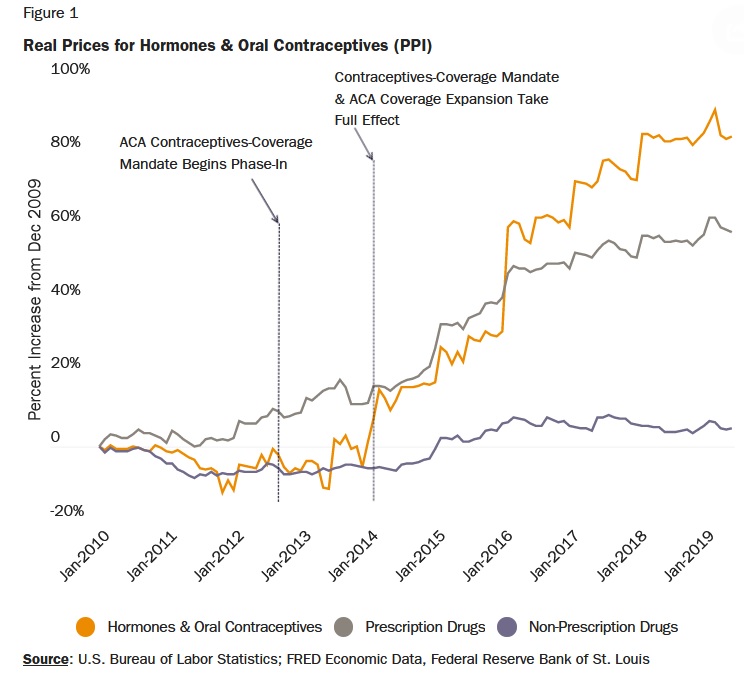
The Affordable Care Act (ACA) dramatically expanded insurance coverage for prescription contraceptives such as “the pill.” From August 2012 through January 2014, the federal government phased in the ACA’s requirement that nearly all private health insurance plans must cover all Food and Drug Administration‐approved prescription contraceptives with no cost‐sharing. …As a result of these changes, the share of consumers who are sensitive to the price of contraceptives plummeted.…among women with large‐employer coverage who use oral contraceptives, “the share experiencing out‐of‐pocket spending…declined from 94 percent in 2012 to 11 percent in 2017.” …The ACA’s reshaping of the market for oral contraceptives precisely coincided with a dramatic increase in prices for those items. …As the mandate began to take effect and as the ACA made oral contraceptives seem “free” to more purchasers, prices for hormones and oral contraceptives began to rise. …Once the mandate took full effect, prices began to rise rapidly. From May 2013 through May 2019, while real prices for non‐prescription drugs and prescription drugs overall rose just 12 percent and 37 percent, respectively, prices for hormones and oral contraceptives rose 108 percent. …these data suggest that trying to make oral contraceptives “free” for insured consumers had the unintended consequence of making them far more expensive.
Here’s the chart, which is a powerful – and depressing – illustration of how government intervention leads to rising prices.
Notice how birth control costs (the orange line) begin to skyrocket as the Obamacare mandate took effect.
Another depressing thing to consider is that consumers get tricked into thinking that birth control is free.
In reality, of course, the higher costs get built in to the price of health insurance, which then means less take-home pay for the people who thought they were benefiting. But since they don’t understand that this is what’s happening, they decide their employers are too greedy or that compensation is stagnant.
Sigh.
Needless to say, the companies selling birth control lobbied to get their product automatically covered. After all, they knew they could raise prices (as shown in the chart) once customers started buying with other people’s money.
P.S. Several years ago, Sandra Fluke got her 15 minutes of fame by asserting that she had a right to third-party-financed birth control. That led to some clever jokes, including this cartoon, these images, this cartoon, and this video.
P.P.S. When markets are allowed to operate in healthcare, relative prices fall.
P.P.P.S. Government-created third-party payer is also generating higher costs and needless bureaucracy in higher education.
Monday, February 17, 2020
This Breakthrough Just Got Us One Step Closer to a Quantum Internet
This Breakthrough Just Got Us One Step Closer to a Quantum Internet: Measuring a quantum state immediately changes it, so any message encoded in quantum states will be corrupted if someone tries to intercept it.
High Frequency Communications Features Highs and Lows By Col. Stephen Hamilton, USA, and Chief Warrant Officer 4 Judy Esquibel, USA
If satellite links go down, HF radios can take up the slack.
If satellite links go down, HF radios can take up the slack.
As cyber threats continue to grow, so does the reality that digital satellite communications can be degraded and denied either through digital or electromagnetic means. If these capabilities are compromised, however, high frequency radio provides a means to continue communicating even beyond the line of sight by leveraging the ionosphere to refract radio signals back to earth.
The International Communication Union Telecommunication Standardization Sector designates the high frequency (HF) range as between 3 megahertz and 30 megahertz. While this method of communication was utilized extensively up through the 1990s, it began to lose traction in the military when the availability of satellite communications (SATCOM) increased.
Among the key differences between HF, very high frequency (VHF) and ultrahigh frequency (UHF) are the multiple antenna configurations required to radiate the signal properly in HF and the atmospheric conditions that greatly affect the propagation of the signal. In addition, choosing the correct frequency for the time of day plays a crucial role in setting up HF communications. Under these conditions and given the proper setup, HF radio signals can be targeted to a geographical region, enabling beyond line-of-sight communication without using satellites.
The growing dependency on SATCOM presents a problem: Because warfighters have been training for SATCOM, the training for effectively employing HF radio has dwindled; radios in the VHF and UHF range have continued to be used for line-of-sight communications.
According to Ronald C. Wilgenbusch and Alan Heisig in an article in Joint Force Quarterly, HF is not a viable option to SATCOM, and they agree the declining amount of training is an issue. “The worldwide system of fixed HF transmitters and antennas that was once the mainstay of our HF communications systems is gone. … Even if it was still in place, the skilled HF operators needed aboard ships and ashore have been cashing retirement checks for years,” they said.
Although the windfall of baby boomer retirements is challenging all government and commercial sectors, it has been especially hard on the computer industry. However, even though many HF-trained military members are separating from the services, a younger generation of enthusiasts is coming from the intersection of do-it-yourself aficionados and hackers. They are tinkering and creating small electronic devices, often using software-defined radios in their projects. They also are exploring various radio frequency-HF communication techniques and developing new hybrid skills.
Even the National Natural Science Foundation of China concluded that HF radio use will lead to self-adaptability and an ever-changing environment. HF radio use also will encourage and leverage machine learning approaches, which will result in the development of smart anti-jamming techniques and equipment. In addition, foundation members believe heterogeneous networking—a combination of HF communications and satellite communications, military networks and civil cellular communications—will enable an integrated space-air-marine-ground communication network.
HF communication using digital modes like FT8 is an example of how techniques evolve with digital communications. The ham and hacker communities have stated that evolving methods could enhance global communications while improving the use of limited spectrum.
There is a trade-off, however. HF data rates are far lower than SATCOM data rates. Consequently, a backup plan must not only detail how to utilize HF transmissions but also outline what data should be transmitted.
For example, it may not be possible to transmit the 2-megabyte battle brief of a PowerPoint slideshow using HF radio; however, the text from the slides could be transmitted without graphics over HF radio. In addition to bandwidth constraints, directing an HF signal to a specific location requires attention to many factors, including frequency, antenna configuration and power.
Using HF radios for communication also poses other challenges that require process and equipment planning. For example, HF radio communications at shorter distances where the environment obstructs line of sight is possible with near vertical incidence skywave (NVIS) propagation. The government communications uses NVIS and has a skywave radio-wave propagation that provides usable signals at distances of up to 400 miles.
The Army Cyber Institute, West Point, New York, recently conducted HF NVIS testing at the National Training Center in Fort Irwin, California. The test included the software JS8Call, the open source program WSJT-X and single sideband modulation voice communication.
To guarantee the propagation was true NVIS, the institute’s team placed stations on either side of Tiefort Mountain and verified that VHF communication was not possible. The team then utilized results from Voice of America Coverage Analysis Program prediction software to determine the proper frequency for the time of day and used a sloped dipole antenna configuration for the NVIS link. The voice link was easily established utilizing 50 watts of power.
Finally, the institute’s team tested WSJT-X to validate FT8 digital communication, which worked as expected, and used JS8Call to send messages, which reduced power consumption considerably and continued to receive JS8Call messages flawlessly.
HF NVIS has been called a “safety net under our infrastructure” that serves as the base layer national fallback network for regional and wide area communications for government, industry, public safety and critical infrastructure when primary systems fail. Initiatives like HF NVIS enable communications resilience and situational awareness within critical infrastructure defense during catastrophic events such as natural disasters, cyber attacks or electromagnetic pulse attacks.
The U.S. Department of Homeland Security Cybersecurity and Infrastructure Agency SHAred RESources (SHARES) HF Radio Program is one example of this safety net. SHARES provides a 24-hour capability to provide an emergency communications link to support intra- or interagency mission requirements.
Col. Stephen Hamilton, USA, is a cyber officer who currently is the technical director of the Army Cyber Institute. Chief Warrant Officer 4 Judy M. Esquibel, USA, is a cyber operations technician and doctoral student in the Department of Information Sciences, Naval Postgraduate School, Monterey, California, and an Army Cyber Institute Fellow.
You may also enjoy:
Sunday, February 16, 2020
Capitalism Helps People in Poor Nations, Foreign Aid Helps Politicians in Poor Nations by Dan Mitchell
I wrote last October about how poor nations that followed the pro-market recipe of the “Washington Consensus” in the 1980s and 1990s got good results. Johan Norberg addresses the same topic in this video.
Sadly, international organizations are infamous nowadays for the bizarre argument that developing nations should try to boost prosperity by imposing higher taxes and bigger government. I’m not joking.
I was even a credentialed participant at a conference on precisely this topic at the United Nations. It was a strange experience to be surrounded by anti-empirical people, but at least I wasn’t threatened with arrest, as happened at an OECD event.
with arrest, as happened at an OECD event.
Needless to say, these folks also think it’s a good idea to use foreign aid to finance bigger fiscal burdens in poor nations.
I’ve previously explained why this is a bad idea, at least if we care about achieving more prosperity for people. Simply stated, there’s considerable evidence that foreign aid retards economic growth by subsidizing bad policy.
Today, though, let’s focus on a different adverse consequence of aid, which is that it erodes the quality of governance.
For instance, the Economist reports on some spiked research from the World Bank, which showed that foreign aid subsidizes corruption.
Their conclusion was dispiriting. World Bank payouts to 22 aid-dependent countries during 1990-2010 were followed by a jump in their deposits in foreign financial havens. The leaks averaged about 5% of the bank’s aidto these countries. …The…working paper…passed an exacting internal review by other researchers in November. But, according to informed sources, publication was blocked by higher officials. They may have been worried about how it would look if the bank’s own researchers said that a chunk of its aid ended up in Swiss bank accounts and the like.

I’m a fan of “Swiss bank accounts” and “foreign financial havens,” but I want them available for taxpayers, not politicians and government insiders.
Sadly, foreign aid helps the wrong people get rich.
Jose Nino draws the most appropriate conclusion.
In 2019, a total of $39.2 billion was spent on foreign assistance, and at a quick glance it has left a lot to be desired. …Foreign aid is not a get-rich-quick scheme for developing countries. Instead of building wealth, it comes with some not-so-pleasant consequences for the recipient nation.…governments receiving aid no longer have to be accountable to their citizens. Knowing that US taxpayers will bail them out, some governments have no incentive whatsoever to innovate or keep corruption in check. …It is the height of naivete to believe that developing countries will magically become rich via wealth transfers from First World countries. It ignores many of the institutions of freedom—private property and federalism—that enabled countries like the US to become the most prosperous societies in human history.
Some folks may think Jose’s conclusion is too sweeping.
So let’s cite some more scholarly evidence.
Three economists, including one from the World Bank, found that foreign aid undermines democracy.
In this paper we investigate the relationship between aid and political institutions. One view of this relationship suggests that aid is needed to advance democratic institutions in developing countries. …A second view holds that foreign aid could leads politicians in power to engage in rent-seeking activities in order to appropriate these resources…By doing so political institutions are damaged because they became less democratic and less representative. Our findings support the second view. Foreign aid damages the political institutions of the country by reducing democratic rules. The magnitudes are striking. If the average share of foreign aid over GDP in a country were 1.9% over the period 1960-1999, then the recipient country would have gone from the average level of democracy in recipient countries in the initial year to a total absence of democratic institutions.

Here’s a graph from the study showing the negative relationship between aid and democracy.
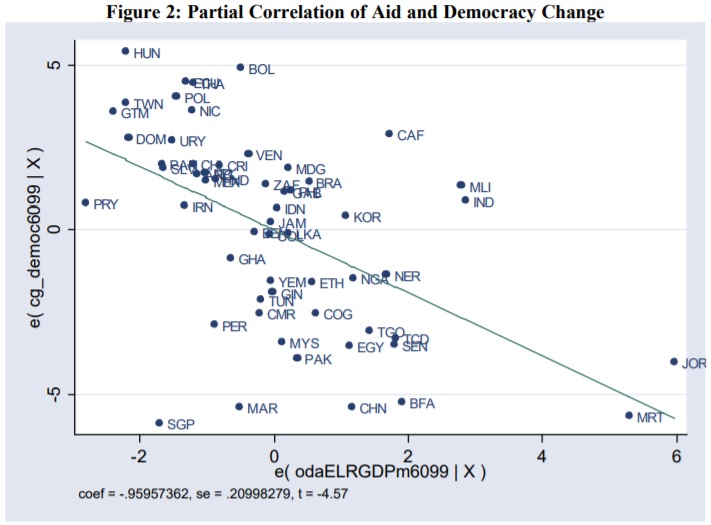
The bottom line is that foreign aid doesn’t work. At least not if the goal is to improve the lives of the less fortunate.
If we want to help poor people in poor nations, the only practical answer is pro-capitalism policies such as small government, rule of law, and free trade.
P.S. Bigger government also enables corruption in rich nations.
Fixing the 990's from http://gm1sxx.blogspot.com/
Hi Again.
Sitting watching an aviation blog on YouTube this morning when I thought.... something's wrong with that bloke's microphone..... but no, it wasn't HIS fault, it was MINE! My lovely Beyer DT990 PRO headphones had a problemo.


Sitting watching an aviation blog on YouTube this morning when I thought.... something's wrong with that bloke's microphone..... but no, it wasn't HIS fault, it was MINE! My lovely Beyer DT990 PRO headphones had a problemo.

The Beyer DT990 Headphones. Easily the most comfortable and excellent phones I've ever owned. Comfortable enough to wear all day.

A quick look at the problem. Not Good!
To get the headphones apart was simple. A small screw on the swivel fork mount between the headphone and overhead mount and you can slide the unit out. I only removed the offending one.
To get inside, pop off the velour ear pads, they are just stretched over a small ledge, and carefully pry off the plastic ring that holds the earpiece in place. A moulded lug on the outside of the ring is THE place to start. Once you pry up the lug a little, a thin screwdriver blade can be carefully run around the edge to pop the ring free. With the ring freed, carefully pry out the driver unit.

A view of the driver unit.
I carefully unsoldered each of the wires. Watch out.... do this quickly with not too much heat!

I cut a few inches off the end of the curly cable where it enters the phones. and peeled off the cover. I've found that cables almost always break close to the end and given that these phones are a good number of years old, it made sense to sacrifice a couple of inches of wire for future reliability.
This is when my problems started! I couldn't get the cable back through the grommet! NOTHING worked until I remembered I had a tub of silicone grease in the shed. With a little grease applied, I managed to push the cable through the grommet and into the body of the headphones. You'll notice the cable colours don't match the wire colours at the solder tags!

A quick shuftie at Canford Audio's website found the wanted wiring diagram above and I used that.
Goes without saying, but I'll say it anyway! Be careful not to overheat the tags when you re-make the connections!
To lock the cable in place, I cleaned off the residual silicone grease with kitchen roll and a bit of Isopropanol then placed a tight wrap of 4 turns of very stiff silver plated wire over the cable with a small blob of epoxy resin for good measure.

All back together and working 100%.
I'm a happy bunny because I love these phones. Mine are DT990PRO 250R types and from memory, I paid about £140 for them quite a few years ago. They are still in production and a bit cheaper now from most suppliers. They are an absolute joy to use.
Just out of interest, I put them on my kitchen scales. 370grams, so not lightweight, but when wearing them they seem to weigh nothing at all, such is their comfort level. Their sound quality speaks for itself. Just simply the best pair of cans I've ever owned.
So glad they are fixed!
Until next time, 73.
Al. GM1SXX
Saturday, February 15, 2020
The Roots of Our Partisan Divide by Christopher Caldwell Senior Fellow, The Claremont Institute and Author, The Age of Entitlement: America Since the Sixties
The following is adapted from a talk delivered on January 28, 2020, at Hillsdale College’s Allan P. Kirby, Jr. Center for Constitutional Studies and Citizenship in Washington, D.C., as part of the AWC Family Foundation lecture series.
American society today is divided by party and by ideology in a way it has perhaps not been since the Civil War. I have just published a book that, among other things, suggests why this is. It is called The Age of Entitlement: America Since the Sixties. It runs from the assassination of John F. Kennedy to the election of Donald J. Trump. You can get a good idea of the drift of the narrative from its chapter titles: 1963, Race, Sex, War, Debt, Diversity, Winners, and Losers.
I can end part of the suspense right now—Democrats are the winners. Their party won the 1960s—they gained money, power, and prestige. The GOP is the party of the people who lost those things.
One of the strands of this story involves the Vietnam War. The antiquated way the Army was mustered in the 1960s wound up creating a class system. What I’m referring to here is the so-called student deferment. In the old days, university-level education was rare. At the start of the First World War, only one in 30 American men was in a college or university, so student deferments were not culturally significant. By the time of Vietnam, almost half of American men were in a college or university, and student deferment remained in effect until well into the war. So if you were rich enough to study art history, you went to Woodstock and made love. If you worked in a garage, you went to Da Nang and made war. This produced a class division that many of the college-educated mistook for a moral division, particularly once we lost the war. The rich saw themselves as having avoided service in Vietnam not because they were more privileged or—heaven forbid—less brave, but because they were more decent.
Another strand of the story involves women. Today, there are two cultures of American womanhood—the culture of married women and the culture of single women. If you poll them on political issues, they tend to differ diametrically. It was feminism that produced this rupture. For women during the Kennedy administration, by contrast, there was one culture of femininity, and it united women from cradle to grave: Ninety percent of married women and 87 percent of unmarried women believed there was such a thing as “women’s intuition.” Only 16 percent of married women and only 15 percent of unmarried women thought it was excusable in some circumstances to have an extramarital affair. Ninety-nine percent of women, when asked the ideal age for marriage, said it was sometime before age 27. None answered “never.”
But it is a third strand of the story, running all the way down to our day, that is most important for explaining our partisan polarization. It concerns how the civil rights laws of the 1960s, and particularly the Civil Rights Act of 1964, divided the country. They did so by giving birth to what was, in effect, a second constitution, which would eventually cause Americans to peel off into two different and incompatible constitutional cultures. This became obvious only over time. It happened so slowly that many people did not notice.
Because conventional wisdom today holds that the Civil Rights Act brought the country together, my book’s suggestion that it pulled the country apart has been met with outrage. The outrage has been especially pronounced among those who have not read the book. So for their benefit I should make crystal clear that my book is not a defense of segregation or Jim Crow, and that when I criticize the long-term effects of the civil rights laws of the 1960s, I do not criticize the principle of equality in general, or the movement for black equality in particular.
What I am talking about are the emergency mechanisms that, in the name of ending segregation, were established under the Civil Rights Act of 1964. These gave Washington the authority to override what Americans had traditionally thought of as their ordinary democratic institutions. It was widely assumed that the emergency mechanisms would be temporary and narrowly focused. But they soon escaped democratic control altogether, and they have now become the most powerful part of our governing system.
How Civil Rights Legislation Worked
There were two noteworthy things about the civil rights legislation of 1964 and 1965.
The first was its unprecedented concentration of power. It gave Washington tools it had never before had in peacetime. It created new crimes, outlawing discrimination in almost every walk of public and private life. It revoked—or repealed—the prevailing understanding of freedom of association as protected by the First Amendment. It established agencies to hunt down these new crimes—an expanded Civil Rights Commission, an Equal Employment Opportunity Commission (EEOC), and various offices of civil rights in the different cabinet agencies. It gave government new prerogatives, such as laying out hiring practices for all companies with more than 15 employees, filing lawsuits, conducting investigations, and ordering redress. Above all, it exposed every corner of American social, economic, and political life to direction from bureaucrats and judges.
To put it bluntly, the effect of these civil rights laws was to take a lot of decisions that had been made in the democratic parts of American government and relocate them to the bureaucracy or the judiciary. Only with that kind of arsenal, Lyndon Johnson and the drafters thought, would it be possible to root out insidious racism.
The second noteworthy thing about the civil rights legislation of the 1960s is that it was kind of a fudge. It sat uneasily not only with the First Amendment, but with the Constitution as a whole. The Voting Rights Act of 1965, passed largely to give teeth to the 14th Amendment’s guarantee of equal rights for all citizens, did so by creating different levels of rights for citizens of southern states like Alabama and citizens of northern states like Michigan when it came to election laws.
The goal of the civil rights laws was to bring the sham democracies of the American South into conformity with the Constitution. But nobody’s democracy is perfect, and it turned out to be much harder than anticipated to distinguish between democracy in the South and democracy elsewhere in the country. If the spirit of the law was to humiliate Southern bigots, the letter of the law put the entire country—all its institutions—under the threat of lawsuits and prosecutions for discrimination.
Still, no one was too worried about that. It is clear in retrospect that Americans outside the South understood segregation as a regional problem. As far as we can tell from polls, 70-90 percent of Americans outside the South thought that blacks in their part of the country were treated just fine, the same as anyone else. In practice, non-Southerners did not expect the new laws to be turned back on themselves.
The Broadening of Civil Rights
The problem is that when the work of the civil rights legislation was done—when de jure segregation was stopped—these new powers were not suspended or scaled back or reassessed. On the contrary, they intensified. The ability to set racial quotas for public schools was not in the original Civil Rights Act, but offices of civil rights started doing it, and there was no one strong enough to resist. Busing of schoolchildren had not been in the original plan, either, but once schools started to fall short of targets established by the bureaucracy, judges ordered it.
Affirmative action was a vague notion in the Civil Rights Act. But by the time of the Supreme Court’s 1978 Bakke decision, it was an outright system of racial preference for non-whites. In that case, the plaintiff, Alan Bakke, who had been a U.S. Marine captain in Vietnam, saw his application for medical school rejected, even though his test scores were in the 96th, 94th, 97th, and 72nd percentiles. Minority applicants, meanwhile, were admitted with, on average, scores in the 34th, 30th, 37th, and 18th percentiles. And although the Court decided that Bakke himself deserved admission, it did not do away with the affirmative action programs that kept him out. In fact, it institutionalized them, mandating “diversity”—a new concept at the time—as the law of the land.
Meanwhile other groups, many of them not even envisioned in the original legislation, got the hang of using civil rights law. Immigrant advocates, for instance: Americans never voted for bilingual education, but when the Supreme Court upheld the idea in 1974, rule writers in the offices of civil rights simply established it, and it exists to this day. Women, too: the EEOC battled Sears, Roebuck & Co. from 1973 to 1986 with every weapon at its disposal, trying to prove it guilty of sexism—ultimately failing to prove even a single instance of it.
Finally, civil rights came to dominate—and even overrule—legislation that had nothing to do with it. The most traumatic example of this was the Immigration Reform and Control Act of 1986. This legislation was supposed to be the grand compromise on which our modern immigration policy would be built. On the one hand, about three million illegal immigrants who had mostly come north from Mexico would be given citizenship. On the other hand, draconian laws would ensure that the amnesty would not be an incentive to future migrants, and that illegal immigration would never get out of control again. So there were harsh “employer sanctions” for anyone who hired a non-citizen. But once the law passed, what happened? Illegal immigrants got their amnesty. But the penalties on illegal hiring turned out to be fake—because, to simplify just a bit, asking an employee who “looks Mexican” where he was born or about his citizenship status was held to be a violation of his civil rights. Civil rights law had made it impossible for Americans to get what they’d voted for through their representatives, leading to decades of political strife over immigration policy that continues to this day.
A more recent manifestation of the broadening of civil rights laws is the “Dear Colleague” letter sent by the Obama Education Department’s Office for Civil Rights in 2011, which sought to dictate sexual harassment policy to every college and university in the country. Another is the overturning by judges of a temporary ban on entry from certain countries linked to terrorism in the first months of the Trump administration in 2017.
These policies, qua policies, have their defenders and their detractors. The important thing for our purposes is how they were established and enforced. More and more areas of American life have been withdrawn from voters’ democratic control and delivered up to the bureaucratic and judicial emergency mechanisms of civil rights law. Civil rights law has become a second constitution, with powers that can be used to override the Constitution of 1787.
The New Constitution
In explaining the constitutional order that we see today, I’d like to focus on just two of its characteristics.
First, it has a moral element, almost a metaphysical element, that is usually more typical of theocracies than of secular republics. As we’ve discussed, civil rights law gave bureaucrats and judges emergency powers to override the normal constitutional order, bypassing democracy. But the key question is: Under what conditions is the government authorized to activate these emergency powers? It is a question that has been much studied by political thinkers in Europe. Usually when European governments of the past bypassed their constitutions by declaring emergencies, it was on the grounds of a military threat or a threat to public order. But in America, as our way of governing has evolved since 1964, emergencies are declared on a moral basis: people are suffering; their newly discovered rights are being denied. America can’t wait anymore for the ordinary democratic process to take its course.
A moral ground for invoking emergencies sounds more humane than a military one. It is not. That is because, in order to justify its special powers, the government must create a class of officially designated malefactors. With the Civil Rights Act of 1964, the justification of this strong medicine was that there was a collection of Southern politicians who were so wily and devious, and a collection of Southern sheriffs so ruthless and depraved, that one could not, and was not morally obliged to, fight fair with them.
That pattern has perpetuated itself, even as the focus of civil rights has moved to American institutions less obviously objectionable than segregation. Every intervention in the name of rights requires the identification of a malefactor. So very early on in the gay marriage debate, those who believed in traditional marriage were likened to segregationists or to those who had opposed interracial marriage.
Joe Biden recently said: “Let’s be clear: Transgender equality is the civil rights issue of our time. There is no room for compromise when it comes to basic human rights.” Now, most Americans, probably including Joe Biden, know very little about transgenderism. But this is an assertion that Americans are not going to be permitted to advance their knowledge by discussing the issue in public or to work out their differences at the ballot box. As civil rights laws have been extended by analogy into other areas of American life, the imputation of moral non-personhood has been aimed at a growing number of people who have committed no sin more grievous than believing the same things they did two years ago, and therefore standing in the way of the progressive juggernaut.
The second characteristic of the new civil rights constitution is what we can call intersectionality. This is a sociological development. As long as civil rights law was limited to protecting the rights of Southern blacks, it was a stable system. It had the logic of history behind it, which both justified and focused its application. But if other groups could be given the privilege of advancing their causes by bureaucratic fiat and judicial decree, there was the possibility of a gradual building up of vast new coalitions, maybe even electoral majorities. This was made possible because almost anyone who was not a white heterosexual male could benefit from civil rights law in some way.
Seventy years ago, India produced the first modern minority-rights based constitution with a long, enumerated list of so-called “scheduled tribes and castes.” Eventually, inter-group horse trading took up so much of the country’s attention that there emerged a grumbling group of “everyone else,” of “ordinary Indians.” These account for many of the people behind the present prime minister, Narendra Modi. Indians who like Modi say he’s the candidate of average citizens. Those who don’t like him, as most of the international media do not, call him a “Hindu nationalist.”
We have a version of the same thing happening in America. By the mid-1980s, the “intersectional” coalition of civil rights activists started using the term “people of color” to describe itself. Now, logically, if there really is such a thing as “people of color,” and if they are demanding a larger share of society’s rewards, they are ipso facto demanding that “non–people of color” get a smaller share. In the same way that the Indian constitution called forth the idea of a generic “Hindu,” the new civil rights constitution created a group of “non–people of color.” It made white people a political reality in the United States in a way they had never been.
Now we can apply this insight to parties. So overpowering is the hegemony of the civil rights constitution of 1964 over the Constitution of 1787, that the country naturally sorts itself into a party of those who have benefitted by it and a party of those who have been harmed by it.
A Party of Bigots and a Party of Totalitarians
Let’s say you’re a progressive. In fact, let’s say you are a progressive gay man in a gay marriage, with two adopted children. The civil rights version of the country is everything to you. Your whole way of life depends on it. How can you back a party or a politician who even wavers on it? Quite likely, your whole moral idea of yourself depends on it, too. You may have marched in gay pride parades carrying signs reading “Stop the Hate,” and you believe that people who opposed the campaign that made possible your way of life, your marriage, and your children, can only have done so for terrible reasons. You are on the side of the glorious marchers of Birmingham, and they are on the side of Bull Connor. To you, the other party is a party of bigots.
But say you’re a conservative person who goes to church, and your seven-year-old son is being taught about “gender fluidity” in first grade. There is no avenue for you to complain about this. You’ll be called a bigot at the very least. In fact, although you’re not a lawyer, you have a vague sense that you might get fired from your job, or fined, or that something else bad will happen. You also feel that this business has something to do with gay rights. “Sorry,” you ask, “when did I vote for this?” You begin to suspect that taking your voice away from you and taking your vote away from you is the main goal of these rights movements. To you, the other party is a party of totalitarians.
And that’s our current party system: the bigots versus the totalitarians.
If either of these constitutions were totally devoid of merit, we wouldn’t have a problem. We could be confident that the wiser of the two would win out in the end. But each of our two constitutions contains, for its adherents, a great deal worth defending to the bitter end. And unfortunately, each constitution must increasingly defend itself against the other.
When gay marriage was being advanced over the past 20 years, one of the common sayings of activists was: “The sky didn’t fall.” People would say: “Look, we’ve had gay marriage in Massachusetts for three weeks, and I’ve got news for you! The sky didn’t fall!” They were right in the short term. But I think they forgot how delicate a system a democratic constitutional republic is, how difficult it is to get the formula right, and how hard it is to see when a government begins—slowly, very slowly—to veer off course in a way that can take decades to become evident.
Then one day we discover that, although we still deny the sky is falling, we do so with a lot less confidence.
Subscribe to:
Posts (Atom)