Winter Field Day, Summer Field Day, "Summits On The Air" with W7MRC, Amateur Radio, Rhodesian Ridgebacks, Field Craft, Living in Montana, Old 4 Wheel Drives, Old Tube Radios, Hiking and "Just Getting Out There"
I am not bullish about China’s economy. Even 10 or more years ago, when many people thought China was going to be the economic superpower of the 21st century, I poured cold water on those predictions.
And this is leading some people to “vote with their feet.” Here are some excerpts from a story in the New York Times by Li Yuan.
They went to the best universities in China and in the West. They lived middle-class lives in Beijing, Shanghai and Shenzhen and worked for technology companies at the center of China’s tech rivalry with the United States. Now they are living and working in North America, Europe, Japan, Australia — and just about any developed country. Chinese — from young people to entrepreneurs — are voting with their feet to escape political oppression, bleak economic prospects… Increasingly, the exodus includes tech professionals and other well-educated middle-class Chinese. …In 2022, despite passport and travel restrictions, more than 310,000 Chinese, on net, emigrated, according to the U.N. data. With three months to go this year, the number has reached the same level as the whole of 2022. …Most of the tech professionals I talked to took a pay cut when they emigrated. “I feel like I’m paying for liberty,” said…a U.S.-educated software engineer who quit his job at an autonomous-driving start-up in Beijing. He now works at an automobile company in Western Europe.
This out-migration is basically a referendum on China’s economic future, and people are voting against bad policy by leaving the country. Including lots of rich people.
Just like people in California, New York, and Illinois are voting against bad policy by leaving those states.
Since I’ve expressing pessimism about China’s future, here’s a tweet from yesterday the helps to further explain my sour outlook.
At the risk of understatement, this is a staggeringly bad idea. China already suffers from awful industrial policy. Imposing European-level taxes would made a bad situation even worse.
Though the fiscal illiterates at the OECD and IMF would be happy.
Picture this: the setting sun paints a cornfield in dazzling hues of amber and gold. Thousands of corn stalks, heavy with cobs and rustling leaves, tower over everyone—kids running though corn mazes; farmers examining their crops; and robots whizzing by as they gently pluck ripe, sweet ears for the fall harvest.
Wait, robots?
Idyllic farmlands and robots may seem a strange couple. But thanks to increasingly sophisticated software allowing robots to “see” their surroundings—a technology called computer vision—they’re rapidly integrating into our food production mainline. Robots are now performing everyday chores, such as harvesting ripe fruits or destroying crop-withering weeds.
With an ongoing shortage in farmworkers, the hope is that machines could help boost crop harvests, reliably bring fresh fruits and veggies to our dinner tables, and minimize waste.
To fulfill the vision, robot farmworkers need to be able to traverse complex and confusing farmlands. Unfortunately, these machines aren’t the best navigators. They tend to get lost, especially when faced with complex and challenging terrain. Like kids struggling in a corn maze, robots forget their location so often the symptom has a name: the kidnapped robot problem.
A new study in Science Robotics aims to boost navigational skills in robots by giving them memory.
Led by Dr. Barbara Webb at the University of Edinburgh, the inspiration came from a surprising source—ants. These critters are remarkably good at navigating to desired destinations after just one trip. Like seasoned hikers, they also remember familiar locations, even when moving through heavy vegetation along the way.
Using images collected from a roaming robot, the team developed an algorithm based on brain processes in ants during navigation. When it was run on hardware also mimicking the brain’s computations, the new method triumphed over a state-of-the-art computer vision system in navigation tasks.
“Insect brains in particular provide a powerful combination of efficiency and effectiveness,” said the team.
Solving the problem doesn’t just give wayward robotic farmhands an internal compass to help them get home. Tapping into the brain’s computation—a method called neuromorphic computing—could further finesse how robots, such as self-driving cars, interact with our world.
An Ant’s Life
If you’ve ever wandered around dense woods or corn mazes, you’ve probably asked your friends: Where are we?
Unlike walking along a city block—with storefronts and other buildings as landmarks—navigating a crop field is extremely difficult. A main reason is that it’s hard to tell where you are and what direction you’re facing because the surrounding environment looks so similar.
Robots face the same challenge in the wild. Currently, vision systems use multiple cameras to capture images as the robot transverses terrain, but they struggle to identify the same scene if lighting or weather conditions change. The algorithms are slow to adapt, making it difficult to guide autonomous robots in complex environments.
Here’s where ants come in.
Even with relatively limited brain resources compared to humans, ants are remarkably brilliant at learning and navigating complex new environments. They easily remember previous routes regardless of weather, mud, or lighting.
They can follow a route with “higher precision than GPS would allow for a robot,” said the team.
One quirk of an ant’s navigational prowess is that it doesn’t need to know exactly where it is during navigation. Rather, to find its target, the critter only needs to recognize whether a place is familiar.
It’s like exploring a new town from a hotel: you don’t necessarily need to know where you are on the map. You just need to remember the road to get to a café for breakfast so you can maneuver your way back home.
Using ant brains as inspiration, the team built a neuromorphic robot in three steps.
The first was software. Despite having small brains, ants are especially adept at fine-tuning their neural circuits for revisiting a familiar route. Based on their previous findings, the team homed in on “mushroom bodies,” a type of neural hub in ant brains. These hubs are critical for learning visual information from surroundings. The information then spreads across the ant’s brain to inform navigational decisions. For example, does this route look familiar, or should I try another lane?
Next came event cameras, which capture images like an animal’s eye might. The resulting images are especially useful for training computer vision because they mimic how the eye processes light during a photograph.
The last component is the hardware: SpiNNaker, a computer chip built to mimic brain functions. First engineered at the University of Manchester in the UK, the chip simulates the internal workings of biological neural networks to encode memory.
Weaving all three components together, the team built their ant-like system. As a proof of concept, they used the system to power a mobile robot as it navigated difficult terrain. The robot, roughly the size of an extra-large hamburger—and aptly named the Turtlebot3 burger— captured images with the event camera as it went on its hike.
As the robot rolled through forested lands, its neuromorphic “brain” rapidly reported “events” using pixels of its surroundings. The algorithm triggered a warning event, for example, if branches or leaves obscured the robot’s vision.
The little bot traversed roughly 20 feet in vegetation of various heights and learned from its treks. This range is typical for an ant navigating its route, said the team. In multiple tests, the AI model broke down data from the trip for more efficient analysis. When the team changed the route, the AI responded accordingly with confusion—wait, was this here before—showing that it had learned the usual route.
In contrast, a popular algorithm struggled to recognize the same route. The software could only follow a route if it saw the exact same video recording. In other words, compared to the ant-inspired algorithm, it couldn’t generalize.
A More Efficient Robot Brain
AI models are notoriously energy-hungry. Neuromorphic systems could slash their gluttony.
SpiNNaker, the hardware behind the system, puts the algorithm on an energy diet. Based on the brain’s neural network structures, the chip supports massively parallel computing, meaning that multiple computations can occur at the same time. This setup doesn’t just decrease data processing lag, but also boosts efficiency.
In this setup, each chip contains 18 cores, simulating roughly 250 neurons. Each core has its own instructions on data processing and stores memory accordingly. This kind of distributed computing is especially important when it comes to processing real-time feedback, such as maneuvering robots in difficult terrain.
As a next step, the team is digging deeper into ant brain circuits. Exploring neural connections between different brain regions and groups could further boost a robot’s efficiency. In the end, the team hopes to build robots that interact with the world with as much complexity as an ant.
Without reform of those programs, the U.S. within a few decades will have a European-sized level of government spending.
Joe Biden and Donald Trump have both stated that they oppose entitlement reform, so this raises the very important question of how they would finance this massive expansion in the burden of government.
Biden’s answer is “tax the rich” while Trump simply pretends the problem doesn’t exist.
Since there’s no way of dealing logically with Trump’s head-in-the-sand approach, let’s address Biden’s supposed solution of soak-the-rich taxes (and keep in mind Biden wants several trillion dollars of new spending on top of the trillions of dollars of higher spending that’s already in the pipeline for existing entitlements).
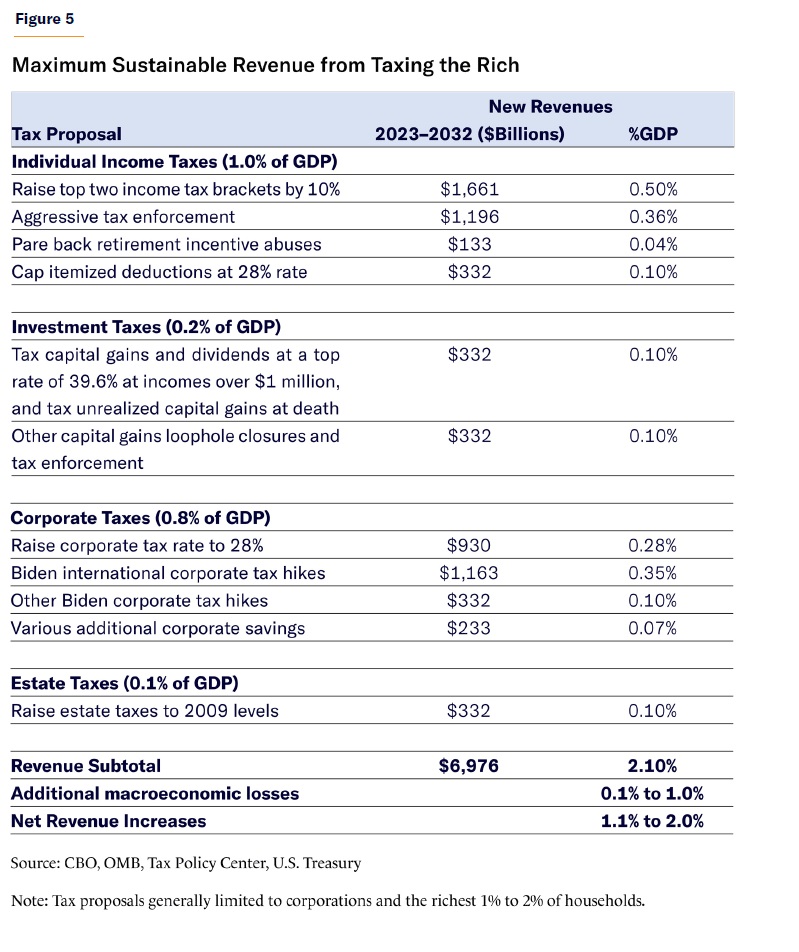
Would 1-2 percent of GDP be enough to finance existing spending promises, as well as Biden’s proposals for more spending?
Not even close. As Brian explains, it doesn’t even deal with current levels of spending.
Budget deficits have risen to nearly 6% of GDP and are projected to rise to 10% of GDP over three decades. …To close these baseline deficits and finance additional expansions, most progressives reject most spending cuts as well as middle-class tax increases. Instead, just “tax the rich” has become an easy and popular answer. However, …the plausible revenue estimates from these proposals fall far short of closing these budget gaps. …America’s federal tax code is already the most progressive in the Organisation for Economic Co-operation and Development (OECD) and has become sharply more progressive over the past 40 years. Much of this tax progressivity is the result of drastic cuts to low- and middle-income taxes while leaving upper-income-tax rates closer to international norms. …Europe’s significantly higher tax revenues are driven overwhelmingly by broad-based consumption and payroll taxes, rather than by notably higher tax rates on the wealthy.
American progressives often hold up Europe—and especially the Scandinavian social democracies of Denmark, Finland, Norway, and Sweden—as successful tax-the-rich utopias that the U.S. should replicate. In reality, European tax systems do not fit the American progressive stereotype, as their higher revenues are overwhelmingly raised through steep income, payroll, and consumption taxes on the middle class.
Here’s a table from the study showing that Denmark, Finland, Norway, and Sweden have slightly higher taxes on income and capital gains, but that’s offset by lower taxes on corporations and lower death taxes.
So what’s the bottom line?
Simply stated, as explained in my Fifteenth Theorem of Government, there is no way to have European-sized government without European-level taxes on lower-income and middle-class households.
As you can see from this table, it’s the only place where there is substantial potential tax revenue.
P.S. There’s one final excerpt from the study I want to share.
…a tax package that reduces annual economic growth rates by 1 percentage point would, in turn, reduce tax revenues by $3.3 trillion over the decade—likely canceling all static tax-revenue gains while also costing jobs and reducing incomes. In other words, tax-the-rich advocates cannot afford to ignore economic considerations. Raising every upper-income-tax rate to its revenue-maximizing level—the point at which the economic damage cancels out any additional revenues—is a recipe for economic stagnation, job losses, and declining incomes.
SB SPCL @ ARL $ARLX013 ARLX013 Solar Eclipse QSO Party Seeks Amateurs and Radio Enthusiasts for Global Experiment
ZCZC AX13 QST de W1AW Special Bulletin 13 ARLX013 From ARRL Headquarters Newington CT October 2, 2023 To all radio amateurs
SB SPCL ARL ARLX013 ARLX013 Solar Eclipse QSO Party Seeks Amateurs and Radio Enthusiasts for Global Experiment
ARRL is proud to partner with HamSCI to help promote participation in the Solar Eclipse QSO Party (SEQP). SEQPs are a series of global experiments — and you can be a part of them. Solar eclipses will pass across the continental United States on October 14, 2023, and April 8, 2024.
During these celestial events, you can join thousands of fellow amateurs as part of the largest crowd-sourced event for ham radio scientific exploration. The SEQP is part of the Festivals of Eclipse Ionospheric Science and is for learning more about how the ionosphere works.
All radio amateurs need to do is operate using any mode and any band for all or part of the day, then upload their logs. Participation can be from anywhere; you don’t need to be near the path of the eclipse to contribute valuable data. You don’t even have to be a licensed ham to participate in the experiment (only to transmit).
If you’re an SWL or AM DXer, you might be interested in the Medium Wave Recording Event. Go to https://www.hamsci.org/mw-recordings/ for more information . Or just get on the air and help provide data to better understand the ionosphere.
The first SEQP is on Saturday, October 14, 2023, from 1200 – 2200 UTC, and participants may use any band or mode (except WARC bands). Researchers will take the submitted logs and work to derive meaningful observations from the data.
ARRL members can find out more about the SEQP by reading “The Solar Eclipse QSO Party: A Fun Way to Support Radio Science” in the September/October 2023 issue of On the Air magazine. The On the Air podcast will feature the article’s author, Gary Mikitin, AF8A, talking about the event. The episode will go live on October 12. NNNN
Recently, I was asked not only how I made out during the Nashua Area Radio Society’s Sep 3, 2023 Club POTA activation from Rollins State Park (K-2676) and Kearsarge Mountain State Forest (K-4918) (it’s a two-fer), but what the gear was that I used. So I decided to “pen” an article with some of the details.
The Box
Jay Francis, KA1PQK and I decided to put my go-box to the test in the field during this activation. It is an unassuming, little old “shack in a box”… although it is a large box… a large dayglow yellow box. So, maybe it isn’t all that little or unassuming after all. But I digress.
My unassuming go-box (the name plate in the center came from HamCrazy.com)
The go-box itself is built around Harbor Freight’s largest protective waterproof ABS case, the Apache 4800. Despite its size, the case lends itself to portability. I literally only need to grab it and my trusty modified Lenovo N23 Chromebook (more on that later) and head out the door. I’ve used this same model Apache case to ship photographic gear all over the country. It works exceptionally well at protecting my gear at roughly 1/2 to 1/3 the cost of a similar Pelican case. I like that, after all, I am a ham.
The go-box contains everything else I will need for an activation in any mode… SSB, CW, or digital. Altogether, the go-box weighs in at around 8 pounds… light enough to easily deploy to most places, but heavy enough that I don’t want to hike with it for a SOTA activation.
The Station
The Radios
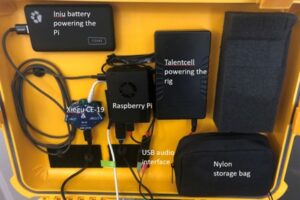
The station itself is designed around a Xiegu G90 SDR Transceiver. The G90 is a 20w, all mode, 10-160m SDR radio with some incredible features for such a reasonably priced rig. It has a built-in antenna tuner that will match nearly anything you can throw at it, a (small but useful) waterfall display, DSP noise reduction, etc. The G90 is powered by a Talentcell rechargeable 12V 6000mAh Lithium-ion battery pack. While intended to charge cell phones via it’s 5v USB ports, the Talentcell has a very convenient 12v output port as well, and provides me with up to 2.5 hours of operating at reasonable output power for the radio.
For SSB, I use the stock Xiegu mic that came with the G90. Surprisingly, for a $450 rig, I have received several positive comments on audio quality! For CW, I use a CW Morse paddle. It is small, but hefty enough that it won’t move around the table when I am using it. As the G90 requires additional hardware for digital interfacing, I use a Xiegu CE19 digital interface kit connected to a Raspberry Pi 4b to allow me to operate FT8, RTTY, and other digital modes.
Finally, I have the Xiegu OEM CI-V USB cable that connects the radio to the Pi allowing for rig control and automatic frequency capture in the various software apps that I use. Xiegu radios use the ICOM CI-V protocols for rig control, which makes them (generally) easy to set up and use.
The go-box also contains a QYT dual band mobile FM radio, powered by an external battery. However, we did not use this radio on the activation.
The Antennas
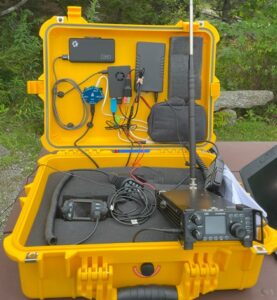
All the RF is forced out of the radio into an MFJ-1899T portable vertical (which also lives in the Apache case when stored). The antenna attaches at the back of the rig to a right-angle connector with a PL259-to-BNC adapter on it. I also have a premeasured and marked counterpoise connected to the G90’s ground point that I deploy to improve the signal.
Jay brought his portable vertical setup as well. It’s an MFJ 2286 portable 7-55MHz antenna on a Husky telescoping tripod. We switched antennas from the 1899T to Jay’s 2286 roughly halfway through the activation. Although I don’t have any empirical data, and my memory is like that of a 130-year-old, I recall that Jay’s vertical worked quite a bit better. No surprise, given that the 1899T is a true compromise antenna. But it does make Q’s.
View of the bottom of the go-box containing the radios and stored antenna.
The Computer
The Pi is powered separately from the radio’s power source by an Iniu 10,000 mAh 5v battery and can run for 6 or so hours on a single charge. As the Pi’s integrated audio hardware is insufficient for use with digital modes, I use an inexpensive Sabrent USB audio dongle which works nicely. For time synchronization, I either manually update the time on the Pi (as was the case on this POTA activation) or use a U-Blox USB GPS dongle connected to the Pi for a GPS time source. I did bring a new solar charger setup with me on this activation, but never deployed it.
The Software
The software on the Pi is a critical part of the entire solution, without which, the whole “shack in a box” concept goes out the window (ask me how I know this). At the base is the Raspberry Pi O/S, which I built from KM4ACK’s awesome Build-a-Pi solution. Although BAP is being replaced by 73 Linux, it is still an excellent quick deployment solution for a Raspberry Pi. The Pi contains a host of software applications that you would find in any shack, as well as some that are specifically EMCOMM related, and some that facilitate portable operation. I’ll go through what we used during the activation and leave the other details for a future article perhaps.
The Pi also has a hot-spot solution that auto starts when no known network is detected. The hot-spot is the real key to the overall shack-in a box solution though… but more on that later. For rig control, FLRig is my go to – it allows FLDigi, WSJT, and my logging program, CQR Log, to have connectivity to the radio. When operating SSB or CW, I simply fire up CQR Log and it starts FLRig, which connects to the radio, and I am off to the races. If I am instead operating digital using WSJT or FLDigi, I need only to tell CQR Log to start either program, and it seamlessly connects and shares QSO data (I say seamlessly now, not so much until I truly figured out how to integrate the software pieces… but that’s for another article too).
View of the top of the go-box case. All of the components are secured to the top by industrial strength Velcro fasteners. Some improvements were made post-activation to control the cables and wires better, and clean things up.
The “Other” Computer
Truly attentive readers may have noticed something missing though… a screen with which to view the Pi desktop. That’s kind of important. This is where the hot-spot feature of the Pi is really handy. It’s also where my Lenovo Chromebook comes into play. Although in reality, the Lenovo is no longer a Chromebook per se, but more of a “Linuxbook”. I removed Chrome from it and installed Debian Linux instead. There are videos on YouTube as to how to do this. It’s a great way to “rehab” an outdated Chromebook that cost $7 on EBay, and Linux is a great choice for portable ops as it is so much more flexible than Windows (in my opinion). I use the Linuxbook to VNC into the Pi and view the desktop. It is a slick solution that I admittedly copied from others. Any device with a VNC software app can be used, provided it can connect to the Pi’s hot-spot network (you do however need to know the password to the hot spot, which I now have written down). This includes Windows systems, iOS devices, Linux devices, Android devices, etc. In a real EMCOMM situation, that level of flexibility is nice.
The decision to include a Pi in the go-box was a simple one for me… having a preconfigured hardware / software solution with all of my apps in a single self-supporting enclosure requiring only a VNC capable device to operate it seemed like a pretty cool idea. So far, barring some experimentation and poor decision making by yours truly, it has proven mostly reliable.
Results
So, how did it do during the activation? We made 23 QSO’s running anywhere from 5 to 20 watts: 21 FT8, and 2 SSB. We contacted hunters all over the country… TX, OK, MS, NC, SC, IL, NH, GA, and even a DX station in England. Several park-goers stopped and talked to us about what we were doing, and we got to explain Ham Radio and POTA to a number of them. While it certainly proved a useable solution for the activation, I am constantly looking at ways to refine it and make it better and more “bullet proof”.
The “fully deployed” box ready for operating.
Here are some links to the various components of the go-box in case you are interested in more details:
Land acknowledgements have been de rigueur the last few years, with many organizations and events acknowledging that they are on the traditional lands of the indigenous nations that had historically inhabited that land. The Native Governance Center suggests that one way to build upon a land acknowledgment is to investigate the indigenous history of the land, to learn the place names, locations, and landmarks of indigenous significance in the area.
This is where learning about Traditional Cultural Places (TCP) comes in, as these places had names millennia before you and I came along. Confederated Tribes of the Colville Reservation Chairman Jarred-Michael Erickson says that one reason for Out There Outdoors readers and others to learn and be aware of these names is that recognizing “the traditional names gives a better understanding of the people who came before us, where we are coming from as tribal people, and to foster an appreciation of the ways of our ancestors.”
TCPs can be religious areas, resource gathering areas (plant, animal, fish and mineral), places associated with stories and legends, archaeological and ethnographic sites, habitation sites, camp sites, rock images, trails, and more. In some respects, this definition covers pretty much the whole of the Inland Northwest, if not North America and the world.
These place names are not to be confused with such acts as renaming Fort George Wright Drive as Whistalks Way. This renaming honors Whistalks, wife of Yakama Chieftain Qualchan. These re-namings matter in a different way because they carry cultural and historical connections that might otherwise be lost despite not being connected to a specific site of indigenous significance.
Probably the most visited TCP site in the Inland Northwest is Riverfront Park and the area around the Spokane Falls itself, which was the largest fishing village in the area. Commemorating that history is the “Place of Truths Plaza,” where statues of indigenous figures can be viewed netting and spearing fish alongside metal figures representing Interior Salish creation myths. But there are many more.
Not only was the area around Riverfront Park a prime fishing location, Marsha Wynecoop of the Spokane Tribe says the area hosted a gathering of the people to not just harvest and cure salmon, but engage in stick games, story telling, dancing and other social activities. Within the park is the former Canada Island, snxw meneɂ, for Salmon People. In many respects, Riverfront Park has returned the area to its original use
Many place names and their history are in danger of being lost due to anglicized naming, while some places have been uniquely inundated behind the waters of the Grand Coulee Dam. One such place is Kettle Falls—known to the Colville, in the English transition, as “Roaring Waters”—where the falls previously fell over 50 feet, ensuring that only the hardiest of fish made it farther upstream to spawn, strengthening the stock for future generations. This run was stopped by the construction of the Grand Coulee Dam. One legend behind Kettle Falls has Coyote bringing Salmon up the Columbia River, creating a diversion to help the fish break the blockade created in the Dalles by Seagull, Kingfish and Snipe. In the process, Coyote also created Okanagan Falls from a pile of salmon bones.
One place that has not been inundated is Palouse Falls, pelúuc. There are two legends behind the creation of the falls. One legend is that four giant brothers had run out of beaver oil, and in attempting to get more, as they fought with beaver, he thrashed about, creating the canyon walls, causing the river to bend and change. The other is that beaver was making a canyon and those living in the area wanted to stop him from doing so. A warrior went to kill beaver, and in the fighting, the canyons and falls were created.
These generally available place names and legends are not even the tip of the iceberg concerning the original names of the places we live in and enjoy in the Inland Northwest. The traditional lands of the Colville Confederation cover 39 million acres that stretched from Eastern Oregon to British Columbia. That range has been reduced to 1.4 million acres of the present reservation. There are mountains, mountain ranges, and so much more not included in current records.
One goal Chairman Erickson has is to get the Washington State Department of Transportation to put indigenous place names on road signs, an effort he hopes will soon be underway. This can help foster awareness of the history of the first people of the region, reestablishing the indigenous legacy and the long-established history of the land. “Place names are important because they show evidence that we have been here since time immemorial, that we have a connection to the place and what is in our history,” says Erickson.
Learning place names, the stories behind them, and bringing those names into current signage is a respectful first step to truly acknowledging the land upon which we live and play.
Bradley Bleck loves digging into the history of the Inland Northwest. He last wrote about Soap Lake and its healing waters for the July/August issue of OTO.
Let’s Keep It Local - LewRockwell: Those of us who support a complete free market often have to face an objection. “Isn’t a Rothbardian program very unlikely to be put into effect soon? Convincing people it’s the right path will take a long time. Meanwhile, what do we do now, within the limits of our current American political system? The great Dr. Ron Paul has the answer to this, and it is an answer Murray Rothbard fully accepted. Our main enemy is the centralized state, now run by brain-dead Biden and his gang of neocon controllers, Because that is true, we should try to move decisions … Continue reading →
Whether at the federal level, state level, or local level, my biggest problem with bureaucrats is that many of them work for agencies and departments that should not exist.
My second biggest problem is that they are overpaid compared to workers in the productive sector of the economy.
But for today’s column, let’s focus on the narrower issue of pensions for state bureaucrats. But we’re not only going to be examining the overly generous guaranteed benefits that politicians have promised.
Those numbers are important. But, courtesy of Reason‘s Pension Integrity Project, we’re also going to see whether politicians have actually set aside the amount of money needed to fund those benefits.
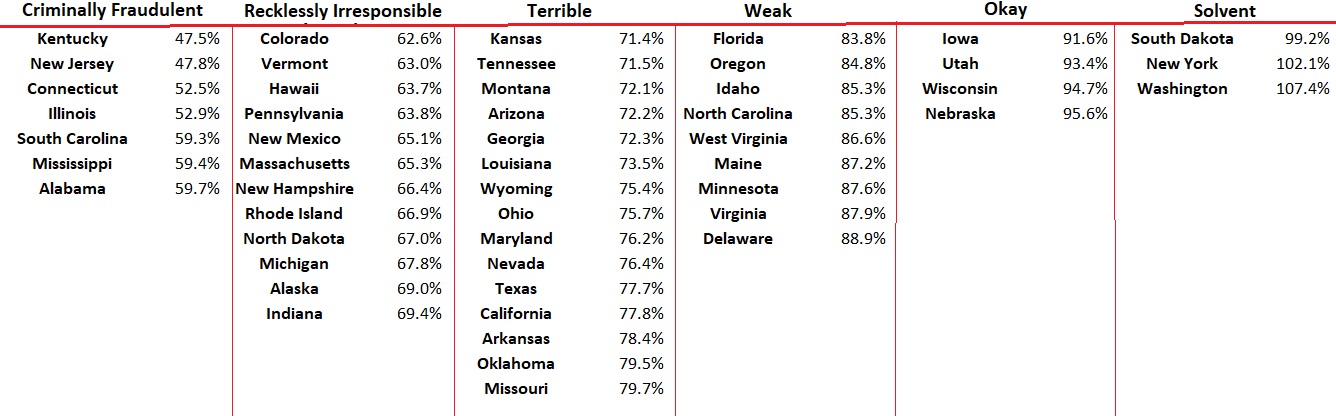
I put Reason‘s numbers into categories to see which states were saddling their residents with future problems (often referred to as unfunded liabilities).
What do we see? Lo and behold, only three states have solvent systems, with four others being in decent shape.
However, to properly assess the future danger to taxpayers, it’s also necessary to know the relative size of state pension plans.
For instance, if a state does not offer a lot of guaranteed benefits, then the future burden on taxpayers won’t be that large, even if the state hasn’t set aside the money to pay those benefits.
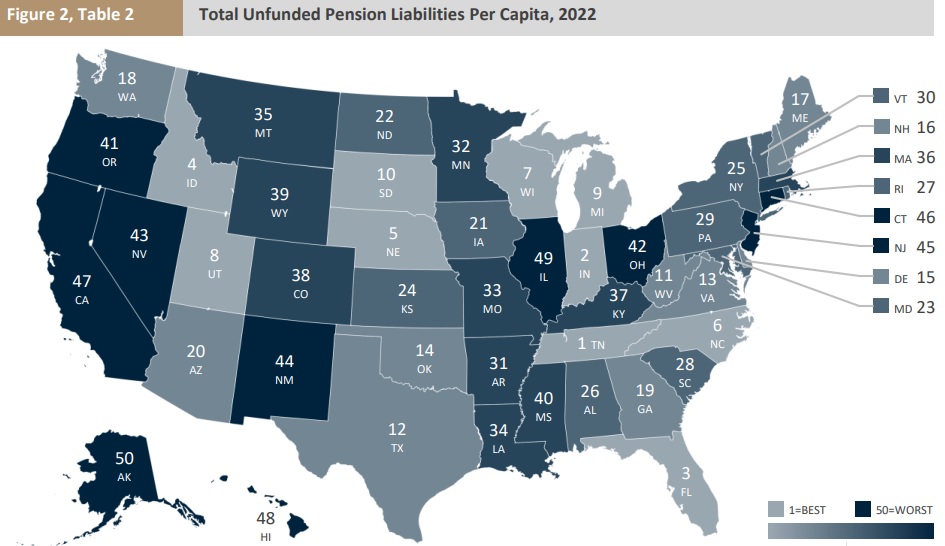
Which is why it’s also important to look at unfunded liabilities per capita. Here are those calculations, courtesy of the folks at the American Legislative Exchange Council.
Measured this way, Tennessee, Indiana, and Florida are in the best shape, even though they don’t look good in the Reason report.
Let’s conclude by seeing what states are in the top-10 and bottom-10 of both reports.
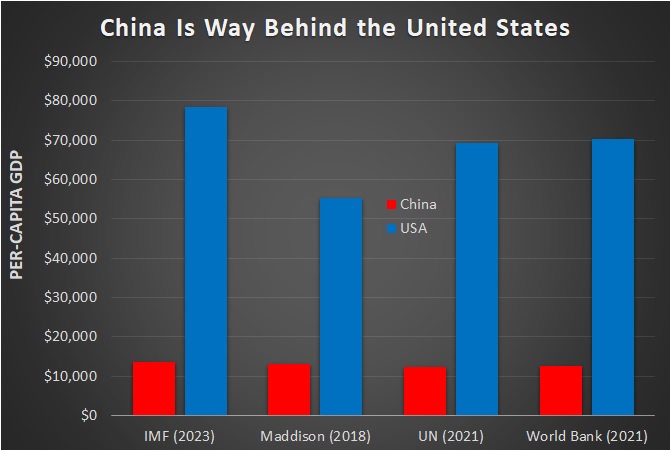 Simply stated, China suffers from too much bad economic policy.
to escape political oppression, bleak economic prospects… Increasingly, the exodus includes tech professionals and other well-educated middle-class Chinese. …In 2022, despite passport and travel restrictions, more than 310,000 Chinese, on net, emigrated, according to the U.N. data. With three months to go this year, the number has reached the same level as the whole of 2022. …Most of the tech professionals I talked to took a pay cut when they emigrated. “I feel like I’m paying for liberty,” said…a U.S.-educated software engineer who quit his job at an autonomous-driving start-up in Beijing. He now works at an automobile company in Western Europe.